Introduction[1]
Nobel Prize-winning economist Robert Lucas once remarked, “Once one starts to think about [economic growth], it is hard to think about anything else.”[2] Given growth’s compounding effect on income and its transformative impact on poverty, his obsession is understandable. Yet this paper asks a different kind of question: What happens when we stop thinking about growth as the only thing worth thinking about? If we decenter growth, what other goods, goals, and ultimate purposes come into view? Taking this omission seriously, we explore how theological reflection, especially Christian accounts of creation, redemption, and human limits, can help us reconsider the role and final aim of economic life.
The concept of purpose, then, is not a neutral addition to economic analysis; it implies a moral anthropology. To speak of ends is to affirm the significance of persons, not merely as consumers but as moral agents. For those ends to be truly ultimate, they must reach beyond current economic arrangements; they must be grounded in transcendence. In this paper, we turn to theology for both ontological and eschatological resources, ways of understanding the world as ordered and purposeful now, and ways of imagining its fulfillment in the future.
Eschatology, the theological study of history’s ultimate end and humanity’s final destiny, is not exclusive to Christianity. In Christian theology, however, it specifically refers to the end of this world and the hope that lies beyond. Broadly construed, secular eschatologies also exist, ranging from dystopian visions such as climate catastrophe or nuclear annihilation to utopian ideals, including the progressive narrative embedded in neoclassical economics and, as we shall see, even in the writings of John Stuart Mill and John Maynard Keynes.
Traditional Christian theology explicitly addresses the ultimate ends of humanity, wider creation, and by implication, the economy. These ultimate ends are best understood in the context of a biblical narrative that has both a beginning and an end (temporally) and ends (teleologically). Just as modern economists speak of the historical beginning of economic growth after the Industrial Revolution (1750–1850), Christian Scripture speaks of Creation as the beginning of an ordered cosmos, and then humanity. The beginning and end themselves, as well as the narrative that connects them, provide a telos for humanity, a narrative that not only frames our economic pursuits within a broader existential context but also challenges us to reconsider the objectives of such growth.
In contrast to theology, neoclassical economists have come to promote technical models of economic growth[3] that direct one’s gaze away from ends (i.e., teloi), possibly because of their utopian flavor. In neoclassical economics, economic growth is perceived as having no end or finality. As long as physical capital is substitutable enough for natural capital, trade, efficiency gains, human capital accumulation, and technical innovations ensure that growth can continue forever.
Things have not always been conceived in this way. No less than Mill and Keynes have wrestled with the possibility of an eventual “end” of economic history. Their visions, though not theological, reflect an intuition that growth must eventually yield to something greater.[4] Their considerations of the ultimate ends of growth came from contemplating the end of absolute scarcity rather than growth per se, but of course the two are closely related. Thus, for wider considerations on the ends of economic growth, we must cease to see growth as merely a technical problem to be solved.
By examining theological reflections, especially Oliver O’Donovan’s account of created order and eschatological fulfillment, as well as recent theological critiques of scarcity and human limits, this paper undertakes a critical analysis of the neoclassical paradigm of economic growth.[5] Drawing also on the reflections of Mill and Keynes, who each foresaw an eventual transition beyond material scarcity, we argue that economic growth should not be treated as an end in itself but subordinated to broader human and moral goods. Christian theology provides a metanarrative that situates economic life within a framework of ordered creation and redemptive purpose. This paper contends that only such a transcendent framework can rightly define the ends of economic activity, offering a theological alternative to the neoclassical vision of endless growth.
Features of Neoclassical Growth Analysis
There are many definitions of “economics,” but within the neoclassical tradition the notion of choices by a so-called representative agent looms large. The content of the representative agent’s preferences in neoclassical models has evolved over time. For our descriptive purposes, we will focus on constrained optimization as the primary mode of operation for this representative agent who, as Lionel Robbins famously said, pursues competing ends with scarce means.[6] The latest version of this, called “preference satisfaction,” is typical in the Anglo-American tradition, and this tradition has had an immense impact on contemporary neoclassical theory. Indeed, of the Nobel laureates in economics between 1969 and 2022, 70 percent were either American or British, with Americans comprising 61 percent and Britons 9 percent.[7]
Some other salient features of neoclassical economic analysis are worth noting. First, economic growth expands the choice set for consumers. Second, if physical capital is sufficiently substitutable for natural capital, economic growth can continue indefinitely through human capital generation, innovation, and trade. Third, more and wider varieties of goods and services are preferred to less. Fourth, and following from the first three, economic growth is optimal. And, to the extent possible, whatever restrictions or constraints agents face should be removed to maximize their utility. An expanded choice set can never make one worse off. Thus, in the neoclassical framework, homo economicus is not without a telos. Continued economic growth, maximizing utility, and the shedding of constraints constitute the teloi. Time is associated with progress because history has had fewer material goods than the present, while the future is expected to have more.
Mill and Keynes’s Brave New World
Like neoclassical economists, John Stuart Mill (1806–1873) and John Maynard Keynes (1883–1946) also emphasized the economic determinants of history and future prospects. Each of these economists begins their analysis with a foundational narrative or “creation story,” positing that most worthwhile economic phenomena come after the Industrial Revolution. Unlike neoclassical economists, though, Mill and Keynes each saw an important marker in the foreseeable future of advanced economies, one that would push society toward different priorities. For Keynes, the marker was the end of the economic problem, conceived as the meeting of society’s absolute economic needs. For Mill, it was when the economy reached its so-called stationary state. For both, their conceptions of how the present economic period would end led them to think about the economy’s ultimate ends.
In “Of the Stationary State,” Mill writes that “the increase [in material] wealth is not boundless.”[8] This perceived natural limit explicitly led him to a question not typically asked by economists who expect continuous progress, namely: What is the goal of economic progress? In other words, the contemplation of the economy’s end or limit pushed Mill to think deeply about the economy’s ultimate ends or purpose. Importantly, Mill did not regard the stationary state with Malthusian pessimism. As he writes, “I cannot, therefore, regard the stationary state of capital and wealth with the unaffected aversion so generally manifested towards it by political economists of the old school. I am inclined to believe that it would be, on the whole, a very considerable improvement on our present condition.”[9] Mill saw the stationary state as an improvement over “the struggle to get on” that characterized a preceding phase of industrial progress. Still, he argued that people may continue to struggle even when they do not need to do so until they are educated “into better things.”[10]
Mill, as well as Keynes, may have had the same creation story assumed in neoclassical economics, as each sees the relevant starting point for a discussion of economic history as the rise in modern economic growth and factors contributing to it. Yet Mill sees the future differently than the neoclassicals do; he sees history culminating in an economic steady state rather than indefinite economic growth.
Keynes provides a potential initial point for this steady state. In Keynes’s 1930 essay “Economic Possibilities for Our Grandchildren,” he predicts a time 100 years hence when advanced economies would generate enough income to meet the basic needs of all its citizens. He forecasted that real GDP per capita would be between four and eight times what it was in 1930.[11] Indeed, this prediction of Keynes has already been met. For example, the US Bureau of Economic Analysis reports US GDP per capita in 2017 dollars was $8,847 in 1930 and $68,501 in 2024, which is almost a seven-fold increase.[12] With such an increase, Keynes believed the economic problem, the problem of absolute scarcity, would be solved, and people could turn their attention from meeting basic needs to other endeavors such as morality and leisure. He writes that “for the first time since his creation, man will be faced with his real, his permanent problem—how to use his freedom from pressing economic cares, how to occupy the leisure, which science and compound interest will have won for him, to live wisely and agreeably and well.”[13] Keynes thus provides the necessary point and Mill provides the sufficient point for the end of current economic history and the transformation to what they saw as a new world.
Coming from a Christian-infused culture, it is not easy to determine how these convictions were shaped by personal, as opposed to atmospheric, Christian faith, but one can detect in Keynes’s opinions a possible reference to the distinction between “freedom from” and “freedom for,” where the former refers to the removal of constraints to create agency, and the latter refers to morally good uses of that agency. In Christian theology, the notions of “from” and “for” are tightly defined around sin and adoption into God’s family, but there are wider implications of the same distinction.[14]
Scholars have questioned Mill’s religiosity, but his personal relationships, church attendance, and financial support of the church suggest a familiarity with and engagement in the Christian faith.[15] Such familiarity and engagement could have influenced his telos. Just as the Bible declares that anyone in Christ is a new creation (2 Cor. 5:17), Mill foresaw the transformation of humanity and society that the establishment of the stationary state could or would bring. And just as the biblical prophet Micah anticipated a future of peace and security, when people will “beat their swords into plowshares” and will sit under their vines and fig trees where “no one shall make them afraid” (Mic. 4:1–4), Mill envisioned a world where all people in countries that attain the level of development of the most advanced economies of his time could “cultivate freely the graces of life.”[16] Moreover, the New Testament tension between the already-but-not-yet nature of the Kingdom of God finds parallel in Mill’s writing. Mill “hope[s], for the sake of posterity, that [humanity] will be content to be stationary, long before necessity compels them to it.”[17] For Mill, the new world is there to be claimed; we do not need to wait for the stationary state to force the issue. We just have to recognize the possibility. In this way, Mill flips the script on what Lucas wrote more than a century later. “There would be as much scope as ever for all kinds of mental culture, and moral and social progress; as much room for improving the Art of Living, and much more likelihood of its being improved, when minds ceased to be engrossed by the art of getting on.”[18] In other words, once one stops thinking about perpetuating economic growth, it’s easier to think about everything else.
Whatever the sources of Mill and Keynes’s teloi, both foresaw challenges in the transition from a world of scarcity to a world of abundance, including the need to address human desires for superiority and the loss of traditional work as a basis for meaning. Like neoclassical economists, Keynes recognized that even when our absolute needs are met, our relative needs, based on our “desire for superiority, may indeed be insatiable.”[19] Keynes also fretted about the loss of our traditional purpose of working to survive: “[He thinks] with dread of the readjustment of the habits and instincts of the ordinary man, bred into him for countless generations, which he may be asked to discard within a few decades.”[20] With people not accustomed to as much leisure as the solution to the economic problem provides, “the old Adam will be so strong in us that everybody will need to do some work if [they are] to be contented,” which he estimated to be about 15 hours per week.[21] The term “the old Adam” alludes to the biblical figure Adam, humanity’s forebear, who, along with his descendants, was condemned to laborious toil as a repercussion of defying God’s command. Keynes did not believe we would be able to fully shake off the old Adam in us even if the economic problem were solved. The better world that Keynes saw ahead would still be hampered by human habits. Likewise, Mill did not believe that the world would automatically be as good as it could be in the new stationary state. Public and private choices could and would still need to be made for improving general welfare. For example, Mill spoke of the necessity of “just institutions” and income redistribution even in the stationary state to help facilitate continued human improvement.[22] Still, for Mill and Keynes, a better world is possible when their future markers of stationary state and material sufficiency are reached; economic history as we know it would end.[23]
Consideration of the end of the present economy not only helped Mill and Keynes contemplate ultimate ends for the economy, but it also helped guide Keynes’s thinking on what society should be doing in the meantime to manage what he saw as the difficult transition from this state of the world to the next. He writes that “there will be no harm in making mild preparations for our destiny, in encouraging, and experimenting in, the arts of life as well as the activities of purpose.”[24] Thus, consideration of the end and of ultimate ends can and should inform our present actions as well.
Today’s high-income economies have already reached the point Keynes predicted where absolute needs could in principle be met (subject to redistributive policies). They are at the point where they could achieve a stationary state by choice or by the natural slowing of economic growth as Mill foresaw. However, neither Keynes nor Mill had an explicit non-material basis for what comes next. They speculated that leisure, arts, morality, income distribution, and environmental conditions would improve.[25] Yet they offer no theory as to why society would choose these goods over others. In fact, on leisure and perhaps for others of these goods as well, Keynes and Mill have thus far been found to be wrong. Leisure time has not risen to the degree Keynes had predicted. For example, the average annual working hours per worker in the United States only fell from 1990 hours in 1950 to 1765 hours in 2019,[26] far above the roughly 780 hours Keynes predicted we would be working now given the “old Adam” in us. Becker and Rayo attribute the failure of economic growth to yield significantly greater leisure to such factors as the higher opportunity cost of leisure as labor income rises, the degree to which consumption is determined relative to the past and to peers, and the degree to which material consumption becomes habit-forming.[27]
In Keynes’s discourse, the transition towards what society might prioritize post-scarcity presents a notable conundrum. Keynes envisions a future where, with the basic needs of society satisfied, there would be a collective moral reawakening to values long upheld by religious and traditional ethics: the condemnation of greed, the rejection of usury, and a disdain for wealth accumulation for its own sake. However, he acknowledges the temporary utility of these shortcomings in overcoming economic scarcity.[28] This pivot represents a profound shift from satisfying material needs to embracing more profound, non-materialistic pursuits. Nevertheless, Keynes stops short of detailing the mechanics of this transition, offering the resolution of material scarcity as merely a starting point for a broader societal evolution toward embracing non-material values, a concept theologian Daniel Bell characterizes as “salvation by production and accumulation.”[29]
Given Keynes’s conundrum, it seems pragmatic and socially beneficial to default to the neoclassical position that implies that the ultimate purpose of the economy is material improvement or comes as a result of material improvement. At least this takes advantage of the current human desire for material improvement relative to both the past and to peers which fuels the innovation required for perpetual growth. However, this position depends on an understanding of the past and present that may not be entirely accurate and on the ability of the economy and the preferences of economic actors to continue along this perceived trajectory. Leisure time, for example, may have failed to rise not only because of opportunity costs and desire for relatively more goods, but also because of inequality and institutional factors affecting working hours. Innovations may not continue to occur at past rates. Economic growth may not continue unabated without catastrophic environmental impact. A saturation of goods and a declining marginal utility of income and wealth may lead to a decline in the importance of consumption relative to non-market sources of well-being. The underlying assumptions of the neoclassical position are thus not without controversy.
To whatever extent the neoclassical assumptions are wrong, though, it seems possible that either material improvement will not continue in perpetuity, or material improvement will not achieve society’s desired ultimate ends for the economy, or both. Thus, because of the specific teleology for the economy found in the neoclassical position, it is of little use to policy and welfare analysis if material improvement cannot be expected to continue or ultimate ends are either not met or unachievable through this means. The value in Mill and Keynes’s writings thus remains. By perceiving the end to the present economy, they open the space for consideration of possible ultimate ends for the economy. Yet they still fall short in arguing for a particular set of ultimate ends for the economy because they present no basis to do so beyond personal preferences, perceived societal preferences, or speculation.
As Christian philosopher Christopher Watkin notes, the end gives meaning to the whole. It is difficult to understand a book, movie, or any other narrative solely based on the middle of it.[30] Not only is the end important, but so is the beginning. Neoclassical economists may not provide an ending, but like Mill and Keynes, they do provide what they consider to be the relevant beginning: the start of sustained economic growth. This growth began around the 1650s in England, accelerating in the 1700s with the process of industrialization coming to some kind of completion in the mid-1800s.[31] Representative of the modern economists’ view that understanding of the economy begins with this igniting of sustained growth, Keynes writes that “from earliest times of which we have record … down to the beginning of the eighteenth century, there was no great change in the standard of life of the average man living in the civilized centres of the earth.”[32] Keynes, like other economists, attributes the “lack of progress” before that “to the remarkable absence of important technical improvements and the failure of capital to accumulate.”[33]
Nonetheless, it has been surprisingly hard to understand why the necessary technological improvement and capital accumulation did not occur in other times and places. Even Nobel Prize-winning economists find it difficult to identify the sufficient conditions for sustained growth in the present: “We do not know the sufficient conditions for growth. We can characterize the successful economies of the postwar period, but we cannot name with certainty the factors that sealed their success, or the factors they could have succeeded without.”[34] Thus, Mill, Keynes, and neoclassical economists have a beginning to the economic story, but not an origin of the economic story. To find a beginning that provides an origin for the economy and an ending that provides ultimate ends for the economy, one must look elsewhere. While secular economists have speculated about the end of growth, Christian theology offers a more comprehensive framework, one grounded in the order of creation and directed toward eschatological fulfillment.
A Christian Theological Response
Oliver O’Donovan’s influential Resurrection and Moral Order: An Outline for Evangelical Ethics offers one basis for critiquing both the neoclassical economic growth and Mill–Keynes narratives, as well as for laying out a transcendent alternative to them. O’Donovan’s development of a Christian theology of nature began in this work, with later developments extending into political theology, and to a more expansive discussion of ethics.[35] Among mainstream evangelical thinkers, he is lauded for his intellectual rigor and theology.[36]
O’Donovan is of interest to Christian economic growth theorists for two reasons. First, his claim to a Christian ethic resides in his distinctively evangelical approach, which grounds his analysis in both the salvific career of Christ (in particular, but not exclusively, in the resurrection), and in a defensible and sophisticated view of scriptural authority.[37] His understanding of theology in ethics is that it is a theory residing between the Scriptures and the praxis of Christian living. His influence appears explicitly in an early and influential integrative piece on economics and theology, where the theorizing took the form of so called Derivative Social Principles.[38] O’Donovan’s understanding of theology is thus a key tool for integrative work which claims the title “evangelical.”
Second, O’Donovan contends that order resides objectively in God’s creation, a realist account of transcendence that he shares with the natural law tradition, as demonstrated in the comprehensive analysis of John Finnis.[39] However, O’Donovan argues that humans not only resist this order through a sinful will but also misunderstand it due to the noetic effects of sin, the notion that sin distorts not only behavior but also human understanding. This, again, returns him to the gospel because although ontologically the creation is ordered, the epistemic grasp of the order is enriched by knowledge in Christ, particularly for the articulation of appropriate ends and means.
Of particular relevance for economics is the notion that creation is ordered. This entails many things, but one thing it implies is that there are limits built into creation. As we outline below, the vision of human flourishing in preference satisfaction is one where limits to material abundance are always unwelcome. At a fundamental level, an orderly creation speaks against this.
The kind of account of Scripture and the Christian gospel provided by O’Donovan makes the narrative from Genesis through Revelation a solid source of knowledge of creation and economics within a Christian tradition. As it happens, this narrative provides not just a beginning, but also an origin story and not just an ending, but also a sense of ultimate ends, as well as the means in which humanity can make use of these. We shall start at the literal beginning with the created order.
Transcendence through Ontology
As Watkin notes, “Genesis 1 presents us with more than a beginning; it presents us with an origin, a privileged account of how things began, which is crucial for understanding how things are.”[40] Unlike other creation accounts, the biblical account does not begin in chaos or conflict; rather, it “is remarkably calm and ordered.” God methodically spoke the world into existence. The differing accounts have implications for society and humanity. Visions of the universe born out of chaos and conflict may beget visions of society and humanity facing chaos and conflict, such as with Marxist class struggle or the Hobbesian “war of all against all,” while visions of the universe born out of peace and order would not.[41]
Modern mainstream economists, including Mill, Keynes, and neoclassicals, generally concur with the notion of an ordered world, forming the basis for the economic “laws” they propose. Yet, as noted before, they have no origin story, only a place where they tend to start their discussions of economic history, namely with the rise of sustained economic growth, and it is on this that they envision a future of progress. However, “abstraction from teleology creates a dangerous misunderstanding of the place of man in the universe. For it supposes that the observing mind encounters an inert creation—not, that is, a creation without movement, but a creation without a point to its movement.”[42]
The question for secular and religious people alike is: to what or to whom are we ordered? All may have the same question, including the likes of Mill, Keynes, and the neoclassicals, but as O’Donovan argues, the question is difficult to answer without reference to the transcendent. Only the relationship between Creator and creature is purely teleological, ordered entirely toward a final end rather than to provisional or instrumental purposes.[43] And for Christian theology, the final purpose of all creation is God’s glory, as Psalm 8 heralds. This revelation already provides useful information as to the teleology of the economy. Either the economy is ordered to humanity and humanity to the glory of God, or humanity can glorify God through the economy, or both orderings apply. In this biblical framework, the economy, then, is a means of human flourishing or glorifying God.
The economy’s final purpose is human flourishing, not to produce output or to end the problem of scarcity, though these may be means or byproducts of the economy working toward its final purpose. Consequently, society does not need to wait for the economy to approach Keynes’s or Mill’s markers to orient themselves to flourishing. Societies can and should do this at all stages of development. Also, if the economy’s purpose is glorifying God directly or through human flourishing, then the basis for Keynes’s concern about a difficult transition to the post-scarcity economy is misplaced. Humans may find it challenging to achieve flourishing or glorify God due to our fallen state or cultural norms; however, solving the economic problem alone is not sufficient to transition humanity from the state of the “old Adam” to that of the new one.
In light of creation’s superabundance and biblical concerns about excess, the neoclassical focus on economic growth—regardless of such considerations as work, rest, health, community, stewardship, poverty, and integrity—warrants careful theological scrutiny. Economic growth may be consistent with Scripture in principle, but not when it takes exploitative, dehumanizing, or environmentally destructive forms.[44] Furthermore, Christian theology gives value to creation independent of humanity. Again, following Psalm 8, the “rest of the created order [does not] find the whole of its teleological fulfilment in serving [humanity]. [Both are] ordered primarily with a ‘supernatural’ ordering, to praise God.”[45]
A Christian critique of growth goes further than the need to avoid human exploitation, or a cavalier disregard for the environment. It will be recalled that Robbins perceived scarcity to be the central feature of the economic problem.[46] A recent theological critique of scarcity by Menzies runs counter to the foundational framing of economics.[47] It argues that Robbins’s formulation relies implicitly on an anthropology that does not respect creaturely limits.
Menzies’s criticism is normative, respecting as it does the usefulness of constrained optimization as a positive modelling device. Constrained optimization provides so much insight precisely because people in fact face all sorts of immovable constraints, such as genes, raw intelligence and time, just to name a few. To be sure, some constraints are chosen optimally, such as when a worker expands the budget constraint by giving up leisure. But there is no escaping some constraint somewhere. In this leisure example, there are only so many hours in a day. It is a reasonable characterization to say that positive economics most often describes how people respond to constraints rather than how people remove constraints. However, the mathematics is clear enough that if constraints can be removed within a simple optimization problem the agent is never worse off. As it is sometimes put, one is never worse off with more choices.
This last observation that sets economics in normative tension with theology, because some limits we observe throughout creation can be understood not as deficiencies but as essential features of a well-ordered cosmos. There are ontological limits that define the nature of each created thing. Stars cannot be trees; humans cannot be God. Each entity has a specific essence and purpose within the larger creation. Then, there are physical limits which establish the conditions for existence. The fine-tuning of physical constants creates the necessary balance for life—if gravity were slightly stronger or weaker stars and planets couldn’t form as they do. Moral limits guide human action toward flourishing. Just as ecological systems require balance, human communities require ethical boundaries to thrive.
Of particular relevance to economics, the Christian creation story has a world that begins with superabundance: “God has not created a world with just enough sustenance, variety, and abundance for survival, but God created a superabundant world fit to foster the flourishing of his creatures.”[48] As Menzies notes, the only way the finite creation can be described as “superabundant” is if there is a range of “right amounts” for creatures to enjoy. In the language of a lost dichotomy: a distinction between needs and wants is required. In this conceptual world, unthinkable to neoclassical economists, one is worse off by having more than one needs, going beyond the “right amount.” This notion in turn implies that the so-called pursuit of happiness can only be described as a moral imperative when it is redescribed as receiving a measure of happiness that is fitting for a creature.
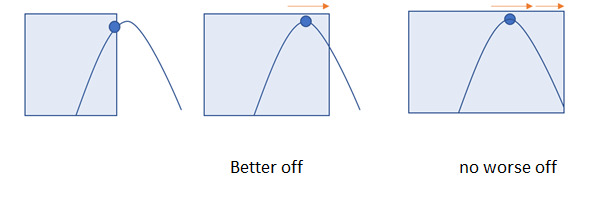
Menzies’s particular critique focusses on the neoclassical modelling of choices by representative agents—so-called preference satisfaction. It is an implication of constrained optimization problems that one cannot be made worse off by having more because constraints are never good. That is, suppose that there is a function of x that must be maximized subject to a restriction on the values that x can take (shown as the shaded box below). As we enlarge the set of values that x can take, one of two things will happen: either the enlargement will allow us to increase the value of the function to be maximized, or we will already be at the maximum, so an enlarged set of x makes no difference. Either way, one can never be made worse off by relaxing a constraint and typically one is better off.[49]
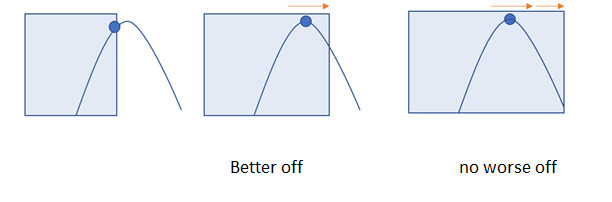
This implies that if homo economicus can choose his constraints then he will always be better off (or at least no worse off) by removing all constraints. To wish for the removal of all constraints is to wish to be God (in power). Thus, preference satisfaction has an uncomfortable picture of the ideal human life: this is a life without limit.
Yet the doctrine of Creation assures us we are finite by design, and the doctrine of Redemption hinges on the divine constraint of the incarnation: “[Christ] made himself nothing, by taking the very nature of a servant, being made in human likeness” (Phil. 2:7). Suffering as constraint is also spoken of positively as it trains (Heb. 12), identifies with Christ in “redemptive suffering” (1 Pet. 4), displays God’s creativity and his power (Rom. 8; 2 Cor. 12), and refines faith (1 Pet. 1; Jas. 1).
Naturally, the finitude of creation is not to be confused with sin—bad choices can reduce a future choice set in ways antithetical to human flourishing. Yet, aside from these cases, humans are nevertheless finite in space, time, knowledge, energy, and perspective. The remedy for finitude involves a recognition that Christians participate in two bodies. One’s own body may be a source of frustration and limitation, but through the Christian’s participation in the universal church (spoken of as a “body,” 1 Cor. 12:27) they can rejoice in the good enacted through this “second body.”[50]
Theologian Kelly Kapic even thinks that God, unlike homo economicus, is not efficient, or at least not in a way that coheres with our limited understanding of what constitutes good means and ends.[51] God takes time for his other purposes, like building communion with his children, in ways that may appear “wasteful.” Kapic suggests we embrace finitude by cultivating rhythms, vulnerability, lament and gratitude, and the Sabbath. The latter is presented by philosopher and theologian Nicholas Wolterstorff as subversion and a sign of true Christian radicalism.[52]
One helpful way to recognize the limits of standard economic theory, without discarding it entirely, is to revisit the original roots of utilitarianism and recover what has been lost. Early utilitarian thought did not treat happiness or pleasure as the highest good. Instead, pleasure was seen as a possible sign of the Good, not the Good itself. When key aspects of creation such as a healthy environment, human dignity, community, and meaningful work[53] are honored, pleasure can serve as a window into God’s will for human flourishing. In William Paley’s original formulation, pleasures are not ultimate ends but potential indicators of deeper purpose, and they can be overridden by other features of a flourishing life.[54] Within this more circumscribed framework, economic theory can continue to offer insights into happiness, but only within the bounds of a well-ordered and just society that respects these moral and creational limits.
Summing up this section, Christianity’s creation story reframes the neoclassical and Mill–Keynes economic narratives. It offers not just a beginning, but an origin story, which includes the order economists presuppose. It also provides a basis for the final purpose of the economy that modern mainstream economics lacks. Moreover, its creation story eschews both reckless growth which violates limits, on the one hand, and endless growth, on the other hand. Christian theology also provides a wider set of values, including Paley’s original and circumscribed notion of utility maximization where pleasure minus pain is a sign of the Good rather than the Good itself.
Not only can Christianity’s creation story place economic narratives in a context of healthy limits, but so too can its eschatology.
Transcendence through Eschatology
Christian theology provides both a beginning and end to the present history of humanity. According to Watkin, “Eschatology is the ‘aha moment’ of the Bible: the ending without which everything that precedes would leave us scratching our heads and wondering how it all fits together.”[55] Crucial to this, Christian theology does not posit that the end will be a return to the beginning, a return to the Garden of Eden. History is linear, not cyclical. Creation is redeemed at the end of the present world according to Christian eschatology. It is this hope for the future that has influenced modern philosophies, including modern mainstream economics: “Modernity is the age of forward-looking hope, and two great philosophies of history dominate its political and social thought. They are the Enlightenment ideal of gradual progress (now commonly identified with free-market [policies]) and the progressive ideal of revolution…. They both borrow from Christian eschatology in different ways and they both fall short of its complexity.”[56]
Like its modern mainstream economics counterpart, Christian eschatology does not foresee the end of creation or see it rendered meaningless. Christ’s resurrection provides for the redemption and transformation not just of mankind, but of all of creation, to be fully realized in his second coming. As O’Donovan articulates:
[Christian] eschatological transformation rules out all the other conceivable eventualities which might have befallen creation, all those ends to which God did not destine it. In the first place it rules out that threatened end of all things which is implied by the Fall: corruption and disintegration. It rules out also the gnostic possibility that creation is to be repudiated or overcome in the name of some higher good. It rules out the possibility that the temporal extension of creation forms a random and meaningless flux.[57]
Even though creation will be transformed, creation is nonetheless valued in Christian eschatology.
Two distinctions between Christian eschatological thinking and the secular economic narratives are worth noting here. First, in Christian eschatology, it is Christ’s redemption that transforms the world, rather than humankind redeeming itself through economic progress as Mill, Keynes, and the neoclassicals would contend. “‘Christ alone’ brings the world-order to its fulfilment.”[58] Still, one can act in the knowledge of the new world to come, even if one cannot bring it about. Schwarz and Tatum call this “proleptic anticipation.” Schwarz writes that “this process of active anticipation strives for a better humanity [and] a more just society.”[59] Thus, Christian theology does not preclude economic policy informed by eschatology. In fact, Tatum offers at least a dozen ways in which eschatological thinking can influence economic analysis and policymaking.[60] Like many thoughtful applications of Christian thought to economics and politics, the influence of the eschaton can be nuanced. To guard against triumphalism, Augustine’s notion of the saeculum is helpful. This is the in-between stage where the citizens of the City of God and the City of the Pagans mix. There is room for improvement, but it is limited, and certainly not utopian.[61]
Second, Scripture affirms that the Christian eschaton remains somewhat shrouded in mystery to humans. Such incomplete information should contribute to a humility in policy advocacy that modern mainstream economics does not seem to share in its pursuit of final ends. At its best, Christian eschatological thinking can critique economic policies or structures, but never sacralize them. Consequently, Christian eschatological thinking leads not only to different ends than secular economics eschatology, but also to a better understanding of our limitations in achieving those ends.
Eschatology and Ontology Connect through Discounting
One way in which the future and the present interact is through the practice of discounting. Since a theological perspective on society and the economy has relevance for both the present (through ontology) and for the future (through eschatology), how might the practice of discounting be affected?
To give discounting its due, it is a key component of cost-benefit analysis where, for example, two projects with different time profiles of net benefits can be compared. Over short timeframes for relatively straightforward problems, such as building a bridge, it is a valuable part of the economist’s toolkit, which can be used for the benefit of humanity. Furthermore, this is perfectly amenable to Paley’s notion of utilitarianism because the relative happiness of people in bridged and bridgeless scenarios count as a sign of the Good when no other higher principles are at stake.
Over very long time horizons, however, things become more complex. A discount factor can reflect either a subjective tendency to undervalue the future or the possibility that future costs and benefits may disappear due to catastrophic events. Once we consider the prospect of such destruction, we inevitably enter into eschatological territory, whether framed in secular or Christian terms.
One might think that relatively recent discounting practices surrounding climate change would provide some insights about how this standard technique should be applied. The noted 2007 report on the economics of climate change, known as The Stern Review, had to choose a discount rate for the future.[62] So much hinged on this rate that it became a point of contention.[63] The discount rate incorporated the idea that eventually the Earth faces destruction, and additionally considers the prospects of future growth. If our children will be poorer than us, for example, it argues for a negative discount rate whereby we restrain current consumption.
A core difficulty here is that any notion of preservation of the created order over very long time scales does not easily fit with calculations about different timing of costs or benefits from, say, building a bridge. The sorts of discount rates that one uses for the latter essentially wipe out any costs or benefits into the far future. For example, a discount rate of a mere 1.0 percent, which gives the future more weight than even the Stern Review, will make costs and benefits after 200 years negligible. Thus, there is no discount rate that will help someone determine the morality of creating Plutonium-239 in a nuclear power program, since it has a half-life of tens of thousands of years.
In framing the problem as a discounting exercise, one risks evacuating a range of other values, including natural beauty and the theological impulse of gratitude toward a Creator. It is perhaps not in keeping with either to subject, for instance, the question of mining the massive ferrous rock at the center of Australia (Uluru, formerly Ayer’s Rock) to a cost-benefit analysis.
Some Christians use the idea of the second coming (Christ’s prospective return to Earth) as a way of justifying a lack of concern for the environment. The idea here is that the Earth will be destroyed, or transformed, and so the question becomes why it should be preserved in the meantime. Implicitly, this is a discounting argument where the cessation of life as we know it encourages a heavy discounting of the future.
We are not in favor of this line of reasoning. Several auxiliary assumptions are invoked in setting up the problem in this way. The first is that the language of destruction of the heavens be taken literally. This has been challenged by many, but notably by the theology of N. T. Wright.[64]
Whilst we acknowledge the methodological “fit” with mainstream economics at this point, a theological control belief overrides the love of elegant mathematics to which we economists are prone.[65] In our view, the intent of the teaching of the second coming is not an invitation to speculation or neglect, but to responsible Christian obedience:
Who then is the faithful and wise servant, whom his master has set over his household, to give them their food at the proper time? Blessed is that servant whom his master will find so doing when he comes. Truly, I say to you, he will set him over all his possessions. But if that wicked servant says to himself, “My master is delayed,” and begins to beat his fellow servants and eats and drinks with drunkards, the master of that servant will come on a day when he does not expect him and at an hour he does not know. (Matt. 24:45–50)
To the extent that stewardship is felt to be a moral responsibility, the doctrine argues for more, not less, concern for the environment. It is thus misguided to motivate a discount rate by the probability of the Kingdom of God appearing and the Earth being destroyed. This direct appeal to the teachings of Christ in shaping our control beliefs takes us to the last insight from O’Donovan.
Knowledge in Christ
Human knowledge is incomplete on this side of the eschaton, but “knowledge is the characteristically human way of participating in the cosmic order. Man takes his place, which is the place of ‘dominion,’ by knowing the created beings around him in a way that they do not know him…. Knowledge is the root of his authority over his fellow-creatures, as it is also the root of the communion which each human being enjoys with his fellow-humans.”[66]
Modern mainstream economics readily accepts the premise that humanity has dominion over the earth and exercises that dominion through knowledge, though it does not acknowledge the divine source of that authority. Whether with the Solow model or more recent endogenous growth models, it is the human ability to find more efficient and unique ways to combine resources that generates sustained economic growth and the human flourishing economists assume will follow.
Without acknowledging the divine source of humanity’s authority—indeed, the divine person of Christ—modern mainstream economics also does not acknowledge the associated responsibilities that come with his authority. It does not recognize limits set by his moral law, only physical and technological constraints to what can be produced. Yet, biblically, “the exercise of knowledge is tied up with the faithful performance of man’s tasks in the world, and that his knowing will stand or fall with his worship of God and his obedience to the moral law.”[67]
Humanity’s reliance on its incomplete knowledge over divine revelation leads to confused ends and means and to idolatry. As O’Donovan writes,
[Mankind] continues to observe generic and teleological order in the things around him; but he misconstrues that order and constructs false and terrifying world-views. So it is that according to the Scriptures, his fallen condition is most typically and characteristically expressed by the sin of idolatry. Idolatry is the distinctive corruption of philosophical knowledge. Animals, plants and stones cannot become idolaters, because to them it was not given to know the order of things…. Only the creature whose task it is to live by the truth of the whole can suffer that fate of living in an illusory universe constructed by his own mind.[68]
Modern mainstream economics is not immune to this, when it exclusively focusses on the means and ends of economic growth.
Humanity will never have complete knowledge on this side of the eschaton, but it can avoid this confusion of ends and means and the idolatry it entails by walking in light of what has been divinely revealed about the eschaton. O’Donovan suggests that any attempt to understand history that does not start with revelation is bound to fall into deterministic views, offering no insight into the future except as an extension of the past, and only through divine prophecy can the true meaning and direction of history be revealed.[69]
Overall, Christian theology provides a metanarrative in which the economics narrative can be couched, a metanarrative of a created order not only with a beginning and end, but also with an origin and final purpose. If the economy’s final purpose is human flourishing and ultimately God’s glory, this rules out production as an end unto itself, the reduction of scarcity as a final end, economic growth as the only means to final ends, and creation as only having value through human flourishing. Humans do not have to possess full knowledge of the eschaton or have the ability to bring it about for it to guide present action; we can act in proleptic anticipation of the eschaton, proceeding with humility given our incomplete information. What knowledge humans do have gives us dominion over creation, as modern mainstream economics readily assumes, but a Christian theological approach should lead us to accept our associated responsibilities and to avoid idolatry. Connections exist between Christian theology and modern mainstream economics, but ultimately, modern mainstream economics lacks a beginning and an ending that gives meaning to everything in between.[70]
Conclusion
This paper has critically examined the limitations of neoclassical economic analysis, particularly its pursuit of growth without reference to ultimate ends. Drawing on the insights of Mill and Keynes, we noted that even within secular economic thought, there are glimpses of longing for a deeper telos beyond accumulation. Yet it is Christian theology, through its doctrines of creation, fall, and redemption, that provides both a true origin and a meaningful end for economic life. By recovering a transcendent ontology grounded in ordered creation and an eschatological hope oriented toward renewal, theology reorients the economy away from unbounded utility maximization and toward the flourishing of persons and the glorification of God. This reframing calls for a richer understanding of the good: one that embraces creaturely limits, values community, honors the created order, and situates economic activity within a moral and spiritual horizon. From this perspective, economic growth is not discarded but redefined: It becomes good when it serves rightly ordered ends grounded in transcendence.
The authors are grateful to Abby Parks for research assistance and to Aubrey Emmett, Linda Topp, Gregory Soderberg, Edd Noell, Cameron Hepburn, and attendees of the 2023 Association of Christian Economists’ Summer Conference, UK Association for Christian Economics Annual Study Group Meeting, Evangelische Theologische Faculteit’s Institute of Leadership and Social Ethics’ Conference on “Economics and Human Flourishing: (What) Can Economists Learn from Theology?,” and the Kirby Laing Centre for Public Theology’s Economics Research Hub for valuable comments.
Robert E. Lucas, Jr., “On the Mechanics of Economic Development,” Journal of Monetary Economics 22, no. 1 (1988): 5.
See Charles I. Jones and Dietrich Vollrath, Introduction to Economic Growth, 3rd ed. (New York: W. W. Norton, 2013), for a canonical text that delivers an outstanding undergraduate technical treatment.
See John Stuart Mill, “On the Stationary State,” in Principles of Political Economy with Some of Their Applications to Social Philosophy, 7th ed. (London: Longmans, 1871); John Maynard Keynes, “Economic Possibilities for Our Grandchildren,” in Essays in Persuasion (New York: W. W. Norton, 1963), 358–73; Amartya Sen, Development as Freedom (New York: Alfred Knopf, 1999).
Oliver O’Donovan, Resurrection and Moral Order: An Outline for Evangelical Ethics, 2nd ed. (Grand Rapids, MI: Eerdmans, 1994); Gordon Menzies, “The Divine Pretensions of Homo Economicus: Limits Must Be Bad,” Journal of Economics, Theology and Religion 5, no. 1 (2025): 45–61.
Lionel Robbins, An Essay on the Nature and Significance of Economic Science, 2nd ed. (London: Macmillan, 1935).
E. H. Dyvik, “Number of Nobel Laureates in Economics by Nationality 1969-2022,” Statista, 2022, accessed December 27, 2023, https://www.statista.com/statistics/262901/nobel-prize-winners-in-economics-by-nationality/.
Mill, Principles of Political Economy, IV.6.2.
Mill, Principles of Political Economy, IV.6.5.
Mill, Principles of Political Economy, IV.6.5–6.
Keynes, Essays in Persuasion, 364–5.
U.S. Bureau of Economic Analysis, “Table 7.1. Selected Per Capita Product and Income Series in Current and Chained Dollars,” National Income and Product Accounts, last modified September 26, 2025, accessed June 10, 2025, https://www.bea.gov/itable/national-gdp-and-personal-income.
Keynes, Essays in Persuasion, 367.
Gordon Menzies, Western Fundamentalism: Democracy, Sex and the Liberation of Mankind (Sydney, 2020). In Galatians 5:1, the Apostle Paul makes the distinction with “It is for freedom that Christ has set us free.”
Timothy Larsen, John Stuart Mill: A Secular Life (Oxford: Oxford University Press, 2018).
Mill, Principles of Political Economy, IV.6.7.
Mill, Principles of Political Economy, IV.6.8.
Mill, Principles of Political Economy, IV.6.9.
Keynes, Essays in Persuasion, 365.
Keynes, Essays in Persuasion, 366.
Keynes, Essays in Persuasion, 368–9.
Mill, Principles of Political Economy, IV.6.9.
Keynes’s phrase “bred into him for countless generations” is particularly fraught given his well-documented involvement in the eugenics movement. As Magness and Hernandez (2017) argue, Keynes’s commitment to population control and hereditary planning persisted into the mature phase of his career, including his leadership roles in the British Eugenics Society. While such language may appear metaphorical, it likely also reflects Keynes’s literal belief in hereditary economic fitness and the technocratic management of population “quality.” This legacy complicates any attempt to interpret Keynes’s post-scarcity vision as morally neutral or implicitly aligned with Christian ethical ideals. See Phillip W. Magness and Sean J. Hernandez, “The Economic Eugenicism of John Maynard Keynes,” Journal of Markets & Morality 20, no. 1 (2017): 79–100.
Keynes, Essays in Persuasion, 373.
Keynes, Essays in Persuasion, 368–73; Mill, Principles of Political Economy, IV.6.7–9.
Groningen Growth and Development Centre, “Penn World Table version 10.01,” DataverseNL, V1, 2023, https://doi.org/10.34894/QT5BCC.
Gary S. Becker and Luis Rayo, “Why Keynes Underestimated Consumption and Overestimated Leisure for the Long Run,” in Revisiting Keynes: Economic Possibilities for Our Grandchildren, ed. Lorenzo Pecchi and Gustavo Piga (Cambridge, MA: MIT Press, 2010), 180–182.
Edd Noell, “An End to Scarcity? Keynes’s Moral Critique of Capitalism and Its Ambiguous Legacy,” Journal of Markets & Morality 20, no. 1 (Spring 2017): 39–53.
Bell, quoted in Noell, “An End to Scarcity?,” 48.
Christopher Watkin, Biblical Critical Theory: How the Bible’s Unfolding Story Makes Sense of Modern Life and Culture (Grand Rapids, MI: Zondervan Academic, 2022), 529, 548.
Max Roser, “Economic Growth,” Our World in Data, 2023, accessed May 16, 2023, https://ourworldindata.org/economic-growth.
Keynes, Essays in Persuasion, 360.
Keynes, Essays in Persuasion, 360.
Commission on Growth and Development, The Growth Report: Strategies for Sustained Growth and Inclusive Development (Washington, DC: World Bank, 2008), 33.
Oliver O’Donovan, The Desire of the Nations: Rediscovering the Roots of Political Theology (Cambridge: Cambridge University Press, 1996); idem, The Ways of Judgment (Grand Rapids, MI: Eerdmans, 2005); idem, Self, World, and Time: Ethics as Theology, vol. 1 (Grand Rapids, MI: Eerdmans, 2013); idem, Finding and Seeking: Ethics as Theology, vol. 2 (Grand Rapids, MI: Eerdmans, 2014); idem, Entering into Rest: Ethics as Theology, vol. 3 (Grand Rapids, MI: Eerdmans, 2017).
See Craig Bartholomew, “Introduction,” in A Royal Priesthood? The Use of the Bible Ethically and Politically: A Dialogue with Oliver O’Donovan, ed. Craig Bartholomew et al. (Grand Rapids, MI: Zondervan Academic, 2002), 1–45; Luke Bretherton, “Introduction: Oliver O’Donovan’s Political Theology and the Liberal Imperative,” Political Theology 9, no. 3 (2008): 265–71; Jonathan Chaplin, “Oliver O’Donovan’s The Ways of Judgment,” Scottish Journal of Theology 61, no. 4 (2008): 477–493; Philip Lorish and Charles Mathewes, “Theology as Counsel: The Work of Oliver O’Donovan and Nigel Biggar,” Anglican Theological Review 94, no. 4 (Fall 2012): 717–36; Andrew Errington, “Oliver O’Donovan as an Evangelical Theologian,” Scottish Episcopal Institute Journal 5, no. 2 (2021): 63–74; Samuel Tranter, Oliver O’Donovan’s Moral Theology: Tensions and Triumphs (London: T&T Clark, 2020).
Errington, “Oliver O’Donovan as an Evangelical Theologian.”
Donald A. Hay, Economics Today: A Christian Critique (Leicester: Apollos, 1989).
John Finnis, Natural Law and Natural Rights (Oxford: Oxford University Press, 1980).
Watkin, Biblical Critical Theory, 54.
Watkin, Biblical Critical Theory, 55.
O’Donovan, Resurrection and Moral Order, 52.
O’Donovan, Resurrection and Moral Order, 33.
Robert Tatum, “Move Beyond the One-Hit Wonder of Economic Growth and Use the Whole Hymnal,” Faith & Economics 76 (Fall 2020): 82–83.
O’Donovan, Resurrection and Moral Order, 38.
Robbins, An Essay on the Nature and Significance of Economic Science.
Menzies, “Divine Pretensions of Homo Economicus.”
Watkin, Biblical Critical Theory, 71.
Menzies, “Divine Pretensions of Homo Economicus.”
Kelly M. Kapic, You’re Only Human: How Your Limits Reflect God’s Design and Why That’s Good News (Grand Rapids, MI: Brazos Press, 2022).
See an argument along these lines in: Alexander William Salter, “What, to the Christian, is Economic Efficiency?” Faith & Economics 82 (Spring 2024): 91–116, https://christianeconomists.org/article/what-to-the-christian-is-economic-efficiency/.
Nicholas Wolterstorff, Until Justice and Peace Embrace: The Kuyper Lectures for 1981 Delivered at the Free University of Amsterdam (Grand Rapids, MI: Eerdmans, 1983), ch. 7.
All of these can be given theological justifications. See Hay, Economics Today.
Graham Cole, “Theological Utilitarianism and the Eclipse of the Theistic Sanction,” Tyndale Bulletin 42, no. 2 (1991): 226–44.
Watkin, Biblical Critical Theory, 529.
Watkin, Biblical Critical Theory, 550.
O’Donovan, Resurrection and Moral Order, 55.
O’Donovan, Resurrection and Moral Order, 65.
Hans Schwarz, Eschatology (Grand Rapids, MI: Eerdmans, 2000), 407.
Robert Tatum, “To What Ends for Theology-Oriented Economic Policymaking?,” Journal of Economics, Theology and Religion 1, no. 1 (2021): 77.
R. A. Markus, Saeculum: History and Society in the Theology of St Augustine (Cambridge: Cambridge University Press, 1988).
Nicholas Stern, The Economics of Climate Change: The Stern Review (Cambridge and New York: Cambridge University Press, 2007).
William D. Nordhaus, “A Review of the Stern Review on the Economics of Climate Change,” Journal of Economic Literature 45 (September 2007): 686–702.
N. T. Wright, The Resurrection of the Son of God (Minneapolis: Fortress Press, 2012).
Wolterstorff, Until Justice and Peace Embrace, 1984.
O’Donovan, Resurrection and Moral Order, 81.
O’Donovan, Resurrection and Moral Order, 81.
O’Donovan, Resurrection and Moral Order, 82.
O’Donovan, Resurrection and Moral Order, 82–83.
A similar critique is offered by Mary Hirschfeld, who argues that modern economics lacks a teleological structure, treating material wealth as an end rather than an instrumental good ordered to human flourishing. See Mary L. Hirschfeld, Aquinas and the Market: Toward a Humane Economy (Cambridge, MA: Harvard University Press, 2018), 210.