“General Johnson expressed the thought that it was an opportune time to review the general concepts which he felt should govern the conduct of the corporation’s affairs. The first concern should be to provide the consuming public with goods of the highest quality. . . . Next in importance he ranked the maintenance of full employment at a fair scale of wages. . . Fourth he placed an adequate return on the capital invested by the stockholders.”[1]
—Minutes of A Meeting of the Board of Directors, Johnson & Johnson, December 13, 1943, at which CEO General Robert Wood Johnson described the company’s Credo prior to its 1944 initial public stock offering.
“Firstly, the corporation is responsible to the shareholders who own the corporation and take all the risk. . . . Employees get paid every day, the communities collect their taxes every day, but the shareholders furnish the capital, the lifeblood of the corporation. And if you do a good job for the shareholders, you will be meeting the needs of the constituencies. When you list a whole lot of constituencies and hope that you’ll do something good for one of them, the corporation can fail as has happened in so many American companies today. . . . Again, the shareholders own the company. They take all the risk. You pay the employees every day. Chief executives who don’t watch out for shareholder value ultimately cause the whole corporation to fail.”
—Former Scott Paper CEO “Chainsaw” Al Dunlap, describing his worldview on the relationship between shareholders and employees.[2]
INTRODUCTION
The purpose of this article is to understand the historical movement toward shareholder-centered models in finance as a response to theoretical difficulties associated with stakeholder-centered models. It highlights key theoretical assumptions, including the elimination of the subjective dimension of work, needed to support shareholder-centered financial models. This reductionism has produced models with analytical clarity, but also has a hidden performative cost (MacKenzie and Millo 2003). Because agents using shareholder-centered models behave in ways that conform to the embedded assumptions in those models, important human values are sometimes dismissed from financial decisions by agents using the models.
One motivation for this historical study is to shed light on the current tension regarding the role of stakeholders and the purpose of the modern firm.[3] The tension captured in the two quotes above stems from a disagreement about whether stakeholder values matter in shareholder-centered models. Advocates of shareholder primacy assert that stakeholder values do matter, at least instrumentally: Firms maximize shareholder value by maximizing the present value of expected future cash flows, which requires managers to provide each stakeholder with market-determined returns for their contribution to firm value. “In this way, successful corporations benefit all of their stakeholders, and what is good for the corporation is generally good for society” (Denis 2019). Opponents assert that by setting up shareholder wealth maximization as the primary goal, finance moves away from a technical discipline toward a value-laden social philosophy asserting what the objectives of the firm ought to be (Alford and Naughton 2002) and influencing the modern telos, or purpose, of the firm.
The Fisher Separation Theorem is the theoretical basis for shareholder primacy and a central idea in this paper. It states that a firm’s investment decisions can be separated from financing decisions, simplifying the investment process for firms to focus solely on investing to maximize shareholder value. Fama (2021, 192) notes that the Fisher Separation Theorem and associated “max shareholder wealth rule is a result, not an assumption,” and a related goal of the current article is to critically examine the embedded assumptions which must be invoked for the Fisher Separation Theorem to hold.
The historical study begins by identifying the taproot of shareholder-centered models in the works of Weber (1904), Fisher (1930), and Robbins (1932). Although the Fisher Separation Theorem is the theoretical basis for shareholder wealth maximization, it was not reflected in mainstream financial thought until the early 1970s, nearly forty years after Fisher laid the foundation. For most of the intervening period, the dominant view in the United States was that shareholder wealth maximization should not be the primary goal of the firm. Berle (1931) was an early advocate that the powers of the corporation should be exercisable for the sole benefit of shareholders,[4] but his was a minority view and counterarguments were commonly expressed that customers and employee needs must come before service to stockholders.[5] For example, as noted above, when Johnson & Johnson issued stock in 1943 on the New York Stock Exchange, “General Johnson expressed the thought that it was an opportune time to review the general concepts which he felt should govern the conduct of the corporation’s affairs. The first concern should be to provide the consuming public with goods of the highest quality. . . . Next in importance he ranked the maintenance of full employment at a fair scale of wages. . . . Fourth he placed an adequate return on the capital invested by the stockholders.”[6]
By 1954, even Berle conceded victory, stating “Twenty years ago, the writer had a controversy with the late Professor E. Merrick Dodd, of Harvard Law School, the writer holding that corporate powers were powers in trust for shareholders while Professor Dodd argued that these powers were held in trust for the entire community. The argument has been settled (at least for the time being) squarely in favour of Professor Dodd’s contention.” Yet within two decades, Friedman (1970) declared that the “social responsibility of business is to increase profits,” and shareholder primacy has been the dominant view ever since. What happened between 1954 and the early 1970s, and why was the earlier work of Fisher (1930) so critical?
The first part of the answer is that Fisher, inspired by the Weberian ideal of value neutrality in economic science, argued that human utility could and should be reduced to measurable wealth and consumption in financial models. Even though economists have always recognized the important reality of subjective human experience, Fisher (1930) and Robbins (1932) explicitly excluded the subjective components of human utility from formal models. Fisher (1930) argued that models should include only those variables that could be measured on an objective, uniform basis (e.g., wealth, consumption, savings). Because subjective experiences could not be measured, they should be omitted from models.
Robbins (1932) highlighted two specific components that were eliminated: meaningful work and social relationships within the context of market transactions. Robbins asserted that these and similar aspects of subjective human experience must be analyzed separately, in aesthetic contexts strictly separate from economic analysis. Robbins recognized the conditions under which such separation might be problematic: when a positive feedback loop exists between the subjective experiences of the agent and the objective outcomes of the economic production process. By noting that such situations cannot always exist, Robbins established the economic modeling practice of assuming that they never exist. A benefit of this strong assumption: The trade-offs between objective factors could be rigorously analyzed in a linear context with one-way causation.
The assumptions of Fisher (1930) and Robbins (1932) did not eliminate stakeholders from the firm’s objective function but did reduce the form of the utility function for both shareholders and other stakeholders. These moves directly eliminated the “subjective dimension of work,” which Pope John Paul II later connected to meaningful work and social relationships within the firm. The objective dimension of work involves the person acting on external objects, creating goods and services through the economic production process. The subjective dimension, by contrast, is “work as a creative process operating on the person performing the work,” a reciprocal process that “returns to the person as an inherent end” (1981, 5, 6). Because human beings “tend toward self-realization,” and because meaningful work is integral to that process, humans are also the subject of work (Friesen 2022a). In modern finance terms, the subjective dimension captures the non-instrumental utility that arises when work contributes to self-development, social belonging, and transcendence, all of which are authenticity-dependent goods that cannot be reduced to wages or productivity (Quinn and Thakor 2018; 2019).
The salience of the subjective dimension has never been greater (Diener and Seligman 2004). Empirical research in psychology, sociology, and organizational behavior consistently finds that meaning, purpose, and social connection at work are decisive predictors of well-being, motivation, and firm performance (Harter et al. 2010; Edmans 2011; Gartenberg et al. 2019; Quinn and Thakor 2019). Knowledge-intensive and service economies depend less on physical capital and more on the relational and moral capital that arise only through authentic cooperation. But most financial models are still structured by the foundational assumptions of Fisher (1930) and Robbins (1932), which reduce utility to measurable consumption and treat labor purely as a means to income.
Even though the foundation was laid, widespread acceptance of shareholder-centered models did not occur until nearly four decades after the work of Fisher and Robbins, because three additional intellectual developments had to occur. First, the question of how best to weigh the interests of multiple stakeholders within the firm needed to be addressed. Arrow (1951) was one of the first to point out that in general, an optimal weighting of these interests is impossible. Arrow’s insight came during an era when mathematical rigor and precision were being integrated into economic models, and models without definitive optima were unattractive to many economists. If balancing the interests of shareholders and stakeholders was theoretically impossible, the natural choice was to include only one of these groups in the firm’s objective function. The widespread opposition to communism and rise of return-focused institutional investors made shareholders the natural choice. This was the second key development.
Even so, managing a firm on behalf of different shareholders with diverse preferences is not equivalent to maximizing the value of the firm’s outstanding shares of stock. Just as Arrow (1951) had shown that this is not possible for different stakeholder groups, Fama and Miller (1972, 68–69) note that
there is, in general, no way of directly combining the preference or utility functions of the individual shareholders into a single global preference function which meets all the axioms of choice and hence which a management could use as an unambiguous criterion for making decisions “in the best interest of the owners.” Fortunately, however, there is at least one important class of circumstances in which we can avoid these and related difficulties of constructing a decision criterion for management directly from shareholders’ preferences.
This important class of circumstances requires certain axiomatic assumptions. Regarding human utility, Fama and Miller (1972, 12) explicitly ruled out all subjective dimensions of human experience from economic analysis, stating “the class of choice problems of most concern in economics as opposed to, say, psychology or aesthetics is that in which the decision maker’s choices are limited by external restrictions.” Subjective dimensions of human reality were explicitly reduced to the exterior dimensions associated with wealth, consumption, or leisure. Fama and Miller also assumed a frictionless capital market, in which lending and borrowing freely occur at a market-determined rate of return. Lastly, applying Fisher’s insights about markets to firms required framing the firm itself as a “private market” or “nexus of contracts.” The result was the Separation Theorem, where operational decisions of the firm are independent of investor preferences. By eliminating the need to specify shareholder preferences, finance obtained a value-free model that justified shareholder wealth maximization as the primary goal of the firm.
One contribution of this historical analysis is the clarification of key embedded assumptions in economic and financial models of the firm. These assumptions are underappreciated by finance academics and practitioners but critical to understand because subconscious assumptions influence our economic stories and decisions (Shiller 2019). Dachler and Enderle (1989, 602) describe how implicit assumptions of business models exert a powerful influence on business decisions, noting that it is through models that a “particular reality is in fact created, since implicit assumptions and their corresponding values govern what one expects to see and experience in the world.” By contrasting these assumptions with more fully human ethical perspectives on business, one may begin to “to overcome the radical separation between both approaches.” (Melé and Fontrodona 2017, 676).
The shareholder-centered models facilitate increased accountability and efficiency within firms and greater alignment of managerial and shareholder interests, which may be compromised in a multi-stakeholder setting (Heath 2006). However, there are several costs to a shareholder-centered culture. For instance, such a culture may compel managers to exclude investments unless such investments can be calculated to increase shareholder value, regardless of the scale of its social benefits or proximity to the firm’s core competencies. In addition, investors may believe that values-aligned investment is unsupported by financial logic or economic theory, particularly when values alignment means investing in firms whose practices support stakeholder well-being in non-calculative ways. Lastly, use of models that explicitly rule out subjective dimensions such as meaningful work or relationships may lead to financial decisions which ignore these factors, even in contexts where they do create financial value. By identifying the historical roots of shareholder-centered models, this article identifies a starting point for financial economists who seek to more fully integrate value-relevant subjective factors into financial theory.
I. Value Neutrality in Finance
Max Weber (1904) was an influential advocate of the idea of value-free objectivity in social sciences, suggesting that sociology (and later economics) could be “value neutral” in a manner analogous to the natural or physical sciences. Gonzales (2013) notes that
during several decades of the last century—from the mid-1920s to the beginning of the 1960s—the main philosophical tendencies considered science as a content that is or might be objective, impersonal and, in principle, independent of the context. Usually, the logico-methodological approaches—verification and falsification—assumed this view. . . . Thus, scientific values, in general, and ethical values, in particular, were not commonly among the contents to be considered philosophically during those decades.
Weber’s injunction required objective, measurable economic models free from human values or subjective interpretation.
A. Irving Fisher and the Subjective Dimension of Work
The primary focus of Fisher (1930) was on understanding price dynamics in markets, particularly interest rates, not explaining the operation of the modern firm or debating the goals of the firm. To the extent the firm even entered the analysis, Fisher focused on an entrepreneurial firm or sole proprietorship operating in a competitive capital market. Nevertheless, Fisher’s framework contained two important intellectual developments for finance.
Fisher’s first intellectual contribution was to argue that the utility could be reduced to observable and measurable dimensions: observable spending and consumption. It is instructive to see exactly how Fisher (1930) justified this reductionism:
Enjoyment income is a psychological entity and cannot be measured directly. We can approximate it indirectly, however, by going one step back of it to what is called real income. . . . These outer events, such as the use of food, or clothes, etc., are like the resultant inner events in not being very easily measured. They occur largely in the privacy of the home; they are often difficult to express in any standard units. They have no common denominator. Even the individual who experiences them cannot weigh and measure them directly. All he can do is to measure the money he paid to get them. (emphasis added)
Two observations are in order: First, all the “exterior” enjoyments given by Fisher are individual and do not involve community or relationships. Second, Fisher assumed that each inner source of utility has a measurable outer physical correlate: enjoyment from music as the music is played; enjoyment from food as the food is eaten; pleasure from clothing as the clothes are worn.
Fisher’s second important intellectual contribution was the introduction of the ideal of a frictionless capital market, in which lending and borrowing could freely occur at a market-determined rate of return. When human utility is reduced to a function of wealth and consumption, the introduction of perfect capital markets produces a “separation result” in which the firm’s production decisions are independent of investor preferences (Hirschleifer 1958). In combination, Irving Fisher’s assumptions laid a foundation for future models of the firm.
B. Lionel Robbins and the Elimination of Meaningful Work and Social Relationships
Two key implications of Fisher (1930) are clearly articulated in Robbins (1932). First, in economic activity one’s relationship with other human beings does not enter the hierarchy of ends: Human relationships must be regarded as instrumental. Second, labor is fundamentally a means to an end rather than an inherent end. Work has no meaning outside of the income it provides. Instead, the employer and the worker form a contract in which the risk-averse agent delivers a certain amount of labor (and no more) for a certain amount of money. Because the effort is personally costly, the worker will supply it only if the employer establishes the proper combination of monitoring or incentives in the work contract.
Robbins (1932, 12) described a “man dividing time between production of real income and enjoyment of leisure.” These statements capture opportunity costs that are central to economics. Robbins (1932) explicitly acknowledges that wealth is a means to maximizing utility, or in his words, “to the maximization of net advantages.”[7] Robbins defends the underlying assumptions about the trade-offs faced by economic man, homo œconomicus (sic), noting that the assumptions ought not to be taken literally. But in doing so, Robbins (1932, 89) points out two assumptions that must be taken literally. First, he states that economic decisions can and must be separate from relationships: “It means . . . that my relation to the dealers does not enter into my hierarchy of ends. For me (who may be acting for myself or my friends or some civic or charitable authority) they are regarded merely as means.” Next, Robbins acknowledges that money and self-interest are ultimately only means to some other, higher end(s). But one’s labor itself must be excluded from that set of ends. “Or, again, if it is assumed . . . that I sell my labour always in the dearest market, it is not assumed that money and self-interest are my ultimate objects. . . . It is assumed only that, so far as that transaction is concerned, my labour is only a means to an end; it is not to be regarded as an end in itself” (emphasis added).
The models of Fisher and Robbins reveal an incompatibility of the models with economic agents who seek “meaning in work,” and the models exemplify the broader social movement of values-free scientific inquiry. Fisher’s theory rested upon several strong assumptions that, in combination, laid a foundation for future models. In Fisher’s model the subjective dimension of work was eliminated, and human preferences were reduced to individual consumption (and, later, often reduced even further to utility of risk and return).[8] When finance models eliminate the subjective and intersubjective dimensions of work, they ignore factors widely considered relevant to value, including meaningful work, human values, transcendent purpose, and meaningful relationships. When such reductive models are used for corporate decision-making, they may create an artificial ceiling on value creation within the firm.
Hsieh (2017) describes how one of these factors, meaning at work, can provide value to workers, suppliers, and even investors in ways that defy conventional trade-off logic. Quinn and Thakor (2018) describe the importance of corporate higher purpose, a component of the subjective dimension of work, noting: “Many executives avoid working on their firms’ purpose. Why? Because it defies what they have learned in business school and, perhaps, in subsequent experience: that work is fundamentally contractual, and employees will seek to minimize personal costs and effort.”
In sum, the assumptions of Fisher (1930) and Robbins (1932) did not eliminate stakeholders from the firm’s objective function, but they did reduce the form of the utility function for both shareholders and other stakeholders. Ironically, as these embedded assumptions slowly developed into formal models over the second half of the twentieth century, the role of work itself in Western society underwent a fundamental shift. Diener and Seligman (2004) describe the nature of this shift: “Economic indicators were extremely important in the early stages of economic development, when the fulfillment of basic needs was the main issue. As societies grow wealthy, however, differences in well-being are less frequently due to income, and are more frequently due to factors such as social relationships and enjoyment at work.”
These assumptions of Fisher and Robbins directly eliminated the subjective dimension of work which involves “work as a creative process operating on the agent performing the work” (Friesen 2022b). Because all humans tend toward self-realization (Maslow 1970), and because meaningful work is an integral component of that self-realization (Diener and Seligman 2004), the person is therefore the subject of work, as John Paul II notes in Laborem Exercens (no. 6): “Man… is a person, that is to say, a subjective being capable of acting in a planned and rational way, capable of deciding about himself, and with a tendency to self-realization. As a person, man is therefore the subject of work. As a person he works, he performs various actions belonging to the work process.”
As Friesen (2020) explains, these reductive assumptions mean that the homo economicus in our models is not fully human, but rather an “economic man with an economic mind” incapable of self-realization. Because the resulting models eliminate the subjective dimension of work, this means that they also rule out “intent-dependent goods” (Quinn and Thakor 2019), including meaningful work, purpose, culture, trust, and dignity. (The value of these depends upon the perceived intention, or authenticity, of those involved in their exchange or production.) In other words, intent constitutes an inseparable part of the good itself. Paradoxically, this means that these goods can produce economic value but only if pursued for purposes other than creating economic value (Quinn and Thakor 2018; 2019; 2020).
Aesthetics and Economics
A brief story helps to illustrate Robbins’s justification for eliminating the subjective dimension of work from models in economics and later finance. In a famous exchange between Lionel Robbins and Sir Josiah Stamp, Robbins (1932) paved the way for the ex-ante rejection of win-win situations by noting that since such situations cannot always exist, the economist is justified in assuming that they never exist. The background was an ongoing debate in England about the extent to which historical artifacts and monuments should be preserved during industrial expansion. This debate reached its apex in the early 1930s at the time both men’s public influence was at its height. Robbins won the debate, and attention to Sir Josiah and his arguments declined rapidly thereafter, but the exchange illustrates how certain rhetorical techniques became foundational in economic and financial thought. Robbins (1932, 28) first characterized Stamp’s position as assuming that ignoring the subjective dimension in business decisions always leads to inferior outcomes:
Sir Josiah, who has done so much to maintain sweetness and light in our times, is anxious to preserve the countryside and to safeguard ancient monuments. (The occasion of the paper was a decision on the part of his railway company not to destroy Stratford House, a sixteenth-century half-timbered building in Birmingham, to make room for railway sidings.) At the same time, he believes that Economics is concerned with material welfare. He is, therefore, driven to argue that “indifference to the æsthetic will in the long run lessen the economic product; that attention to the æsthetic will increase economic welfare.” That is to say, that if we seek first the Kingdom of the Beautiful, all material welfare will be added unto us. And he brings all the solid weight of his authority to the task of stampeding the business world into believing that this is true.
Next, Robbins (1932, 28–29) used a technique of delegitimizing what sometimes doesn’t exist. More specifically, Robbins argued that because such situations cannot always exist, economists are justified in using models which assume that such situations never exist:
It is easy to sympathise with the intention of the argument. But it is difficult to believe that its logic is very convincing. It may be perfectly true, as Sir Josiah contends, that the wide interests fostered by the study of ancient monuments and the contemplation of beautiful objects are both stimulating to the intelligence and restful to the nervous system, and that, to that extent, a community which offers opportunities for such interests may gain in other, “more material,” ways. But it is surely an optimism, unjustified either by experience or by a priori probability, to assume that this necessarily follows. It is surely a fact which we must all recognise that rejection of material comfort in favour of æsthetic or ethical values does not necessarily bring material compensation. There are cases when it is either bread or a lily. Choice of the one involves sacrifice of the other, and, although we may be satisfied with our choice, we cannot delude ourselves that it was not really a choice at all, that more bread will follow. It is not true that all things work together for material good to them that love God. So far from postulating a harmony of ends in this sense, Economics brings into full view that conflict of choice which is one of the permanent characteristics of human existence. Your economist is a true tragedian. (emphasis added)
Stamp was not arguing that such situations always existed but merely that they might exist and that economic decisions should account for this possibility. Nevertheless, the consequence was that the subjective dimension of work was eliminated from economic thinking for nearly a century after this debate. Robbins’s argument thus eliminated the possibility of reciprocal determinism in economic models (Bandura 1986; Shiller 2019), or more specifically the feedback between the realization of certain ends (e.g., engagement or sense of purpose) and the means by which those ends are themselves produced.
II. The Impossible Goal
An important issue that Fisher and Robbins did not address dealt with aggregating utilities across multiple stakeholders or groups. If the firm operates rationally in the interests of multiple stakeholders, as General R. W. Johnson believed Johnson & Johnson should, this requires a way to weight the potentially competing interests of the different groups. It was a practical problem that turned out to be impossible to solve.
A. The Impossibility of Optimally Weighting the Interests of Competing Stakeholders
Rational choice axioms (completeness, transitivity, and independence) ensure coherent individual rankings over alternatives. A social welfare function converts many individual rankings into a single, collective ranking. Arrow (1951) formally proved that under minimal conditions of fairness, it is impossible to construct such a function for a group of diverse agents while also satisfying the three choice axioms. In other words, when we try to aggregate different people’s rankings of outcomes into a single, rational “social ranking,” no rule works in general. Like Arrow, Baumol (1949) analyzed what he called the “community indifference map,” also concluding that no systematic way exists to balance the competing interests of multiple parties while satisfying the axioms of rational choice. The implication for firms and managers is that there is no rational, systematic way to balance the competing interests of different groups with different preferences within a single objective function.
Arrow (1951) showed that while the problem of social choice cannot be solved “in general,” there may be specific ways in which it can be solved. But such solutions nearly always require human values that are translated into weights, applied to the objective functions of different stakeholders. Yet in the “value-free” world of economic science, inspired by Weber and embedded in the models of Fisher and Robbins, the human values needed to balance stakeholder interests were no longer present in economic models.
B. The Need for a Definitive Answer
Arrow’s work made it clear to economists that the problem of maximizing the aggregate utility of the firm’s primary stakeholders lacked a definitive answer, yet the desire for elegant and tractable solutions increasingly influenced the development of economic models of the mid-twentieth century (Heilbroner 1999). An implication of Arrow was that theoretical models and practical managers must choose the interests of either stakeholders or shareholders. At one extreme was Koplin (1963, 135), who stated “The objective of the corporation qua corporation is profit maximization.” Others had misgivings about a singular focus on shareholders. Quoting a popular magazine of his day, Mason (1958, 3) highlighted a change in corporate behavior, and an alternative way of thinking about the goal of the corporation qua corporation: “At the bottom . . . is simple morality. . . . The manager is becoming a professional in the sense that like all professional men he has a responsibility to society as a whole.” Mason was not the first to observe this trend, and Means (1957) coined the term “collective capitalism” to describe this phenomenon. But Arrow had already demonstrated the impossibility of finding a general solution to maximize the “social welfare function” of all the firm’s stakeholders. Mason (1958, 11) suspected that an alternative to profit maximization would have to arise from outside the field of economics:
The attack on the capitalist apologetic of the nineteenth century has been successful, but a satisfactory contemporary apologetic is still to be created. I suspect that, when and if an effective new ideology is devised, economics will be found to have little to contribute. Economists are still so mesmerized with the fact of choice and so little concerned with its explanation, and the concept of the market is still so central to their thought, that they would appear to be professionally debarred from their important task. I suspect that to the formulation of an up-to-date twentieth-century apologetic the psychologists, the sociologists, and, possibly, the political scientists will be the main contributors. It is high time they were called to their job.
Yet the psychologists, sociologists, and political scientists did not contribute to the next stage of economic models as Mason (1958) predicted. One reason was because these social scientists were seen by economists as illegitimate scientists: They studied the subjective or intersubjective dimensions of human experience which had been intentionally eliminated from economic models.
It was not social scientists but social forces that eventually decided the shareholder versus stakeholder dilemma. Throughout the 1960s and early 1970s, the size of conglomerates and the managerial class grew and institutional investors rose to prominence. Blair and Stout (1999) identify several key changes that created an environment that favored shareholder-centered thinking. First, in the late 1960s and early 1970s there was a sizable decline in the aggregate return on capital, and a significant bear market led to large negative returns for shareholders in 1973–74. Second, institutional investors such as mutual funds and pensions grew both in size and influence. The growing concentration of institutional stock ownership facilitated collective investor action and “tipped the political balance of power toward shareholders” (Blair and Stout 1999, 324–5). Stockhammer (2006) highlights the role of the Cold War and strong popular opposition to communism in shaping opinions about the firm in favor of capitalism. In sum, the late 1960s and early 1970s saw a combination of macroeconomic forces, shifting political power, and changes in the structure of institutional investors, all of which favored the hand of stockholders. Without a specific value framework to balance the interests of shareholders and stakeholders, the pendulum swung toward capital. As a result, two axiomatic assumptions emerged during the early 1970s in most Western, English-speaking countries: (1) The surplus of the firm belongs exclusively to the firm’s shareholders; and (2) the firm should be managed exclusively to maximize the utility of the shareholders.
III. The Logic of Markets Applied to Firms
Within the increasingly quantitative and formal field of economics, linear programming was increasingly being used as an analytical tool and was perfectly suited to maximizing any well-specified objective function.[9] As a result, the development of the economic theory of the firm began to conform to the available analytical tools as much as to reality (see e.g., Baumol 1958). Shareholder utility maximization appeared to have a theoretically precise answer to the question of how best to run the modern managerial firm, and the goal of shareholder utility maximization soon began to take shape. Yet it turned out that even this goal did not actually have a unique solution, since Arrow’s result also implied the impossibility of a clear strategy for dealing with the firm’s potentially diverse shareholders with different preferences (see, e.g., Fama 2021). It was only when Fisher’s “logic of markets” was directly applied to firms that a definitive answer was provided in the form of the separation theorem that bears Fisher’s name. This final step occurred when the firm was redefined to be a nexus of legal contracts.
Yet a key economic question was still unanswered: how to best represent the potentially diverse interests of these shareholders. Alchian and Demsetz (1972) proposed a new theory of the firm grounded in information costs. This theory viewed the firm as a legal fiction or “nexus of contracts,” and the resulting framework provided a setting in which the logic of markets could be applied to the understanding of the modern firm. Fama (1980) notes: “The striking insight of Alchian and Demsetz (1972) and Jensen and Meckling (1976) is in viewing the firm as a set of contracts among factors of production. In effect, the firm is viewed as a team whose members act from self-interest but realize that their destinies depend to some extent on the survival of the team in its competition with other teams.” Heath (2006, 539) summarizes the way in which the logic of markets was applied to firms: “The overriding objective of many economists has been to extend the methodological tools—and in particular, the action theory—used in the analysis of markets to model the internal structure of organizations” (emphasis added).
A. The “Separation Theorem”: An Elegant Answer to the Problem of Different Preferences
Fama and Miller (1972) provided the early authoritative treatment of the modern theory of the firm and described a key result known as the Fisher Separation Theorem. This theorem requires several axiomatic assumptions, which Fisher (1930) also made when applying the model to markets. A key difference was that the same assumptions would now be applied to firms. Conceiving the firm as a “nexus of contracts” or a “private market” was the intellectual framework that made this shift possible. The question was “How best to represent the interests of shareholders with different preferences?” The answer: “Shareholder preferences do not actually matter.” Fama and Miller (1972, 68–69) note that
there is, in general, no way of directly combining the preference or utility functions of the individual shareholders into a single global preference function which meets all the axioms of choice and hence which a management could use as an unambiguous criterion for making decisions “in the best interest of the owners.” Fortunately, however, there is at least one important class of circumstances in which we can avoid these and related difficulties of constructing a decision criterion for management directly from shareholders preferences.
This important class of circumstances required Fama and Miller (1972, 12) to explicitly rule out all subjective dimensions of human experience from economic analysis, stating “the class of choice problems of most concern in economics as opposed to, say, psychology or aesthetics is that in which the decision maker’s choices are limited by external restrictions.” Subjective dimensions of human reality are reduced to the exterior dimensions associated with wealth, consumption, or leisure. Fama and Miller also assumed a frictionless capital market, in which lending and borrowing freely occur at a market-determined rate of return. Lastly, applying Fisher’s insights about markets to firms required framing the firm itself as a “private market” or “nexus of contracts.”
The first formal step in this analysis, following Fisher, assumes that the firm and its owners (shareholders) are the only relevant groups to be considered; the firm’s production function is assumed to exist independent of, and abstracted from, any other relevant stakeholders, since these relationships are fully contractualized in their own markets (e.g., customers, employees, suppliers, the local community). In essence, shareholders bear all the risk and as a result are exclusively entitled to the residual income. Customer wages and supply chain contracts are determined in competitive markets, and equilibrium product prices are determined by input costs and consumer demand functions. The outcomes or utilities for any non-equity stakeholders become irrelevant because market forces ensure efficient outcomes for those stakeholders. Market efficiency means that market forces can (and should) regulate stakeholder relationships. The key implication is that the firm can be operated to maximize the market-determined value of common stock and operational decisions are independent of investor preferences. Eliminating the need to specify shareholder preferences produces a values-free model with shareholder wealth maximization as the primary goal of the firm.
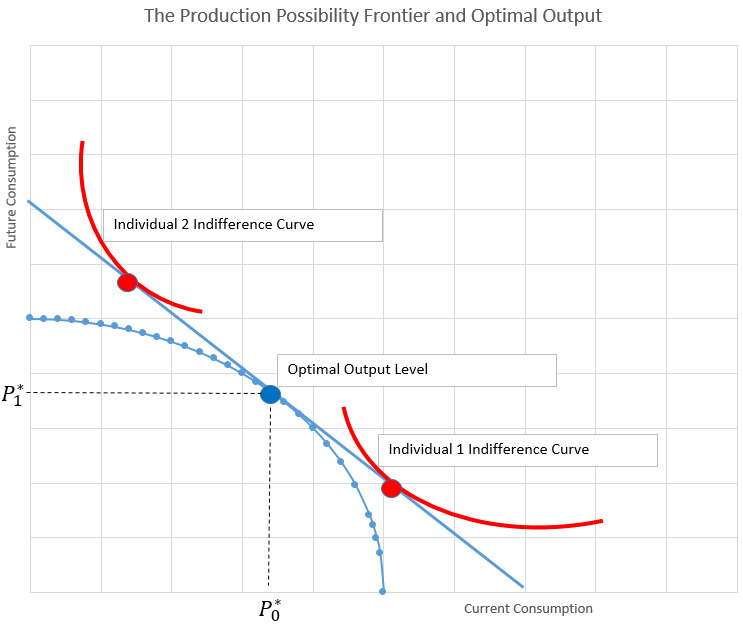
The key implications and intuition are illustrated in Figure 1, reproduced from Friesen (2020), where shareholder utility indifference curves are superimposed on the firm’s production frontier. The introduction of capital markets (the green line in Figure 1) makes all shareholders better off than they are in the absence of the market, because they can use the market to smooth consumption according to individual preferences. The optimal production point, labeled is the point where the capital market line is tangent to the firm’s production frontier.
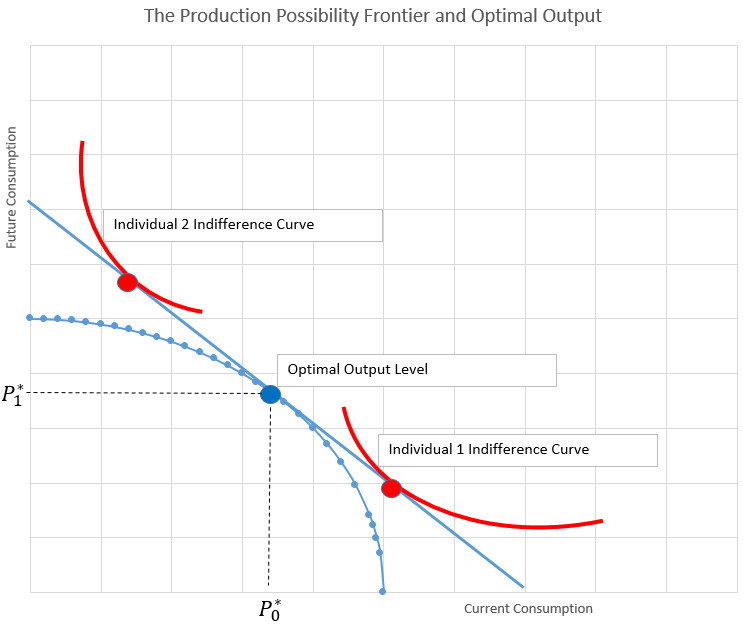
With the availability of risk-free borrowing and lending in capital markets, shareholder utility is maximized when the firm maximizes the value of stock, regardless of the individual shareholder preferences. Once firm value is optimized, individual stockholders borrow or lend in the capital markets to adjust their individual consumption according to their individual risk tolerance and preferences. Thus, maximization of shareholder utility coincides with the maximization of firm value and occurs at a unique optimal level of production. Intuitively, the Fisher Separation Theorem states that if capital markets are perfect, and if investors have unlimited capacity to borrow or lend, and if “value” is reduced to measurable wealth and consumption, then managers can choose projects as if investor preferences and stakeholder well-being do not matter.
It is simple and elegant. And it allows us to partially answer the question “Why the gap of forty years between Fisher (1930) and 1972?” The answer is that it took nearly twenty years for economists to realize that there was no definitive answer to the question of how to optimally weight the utilities of multiple stakeholders and satisfy the axioms of rational choice. That realization forced a choice between stakeholders and shareholders, with political, economic, and institutional forces all emphasizing shareholders. Yet the same problem existed for balancing the interests of different shareholders with heterogeneous preferences. The final catalyst was a shift in the way the firm itself was viewed: as a nexus of contracts within a competitive, efficient, and frictionless market. In this context the goal of maximizing the expected utility of shareholders could be separated from investor preferences and reduced to maximizing the market value of the firm’s stock. Table 1 summarizes this historical development.
Fama (2021) argues that Arrow’s Impossibility Theorem blocks a general stakeholder function, but fails to acknowledge that the same aggregation problem applies to heterogeneous shareholders. In other words, Arrow’s Impossibility Theorem rules out a single, value-neutral welfare function for any diverse group, stakeholders or shareholders. Fama and Miller (1972) avoid this by invoking a “very special class of circumstances” that do not solve Arrow’s problem but simply assume it away: perfect capital markets with unlimited borrowing or lending at the market rate. Under those knife-edge assumptions, firms maximize market value and investors customize their cashflows or consumption by borrowing and lending, making preference aggregation unnecessary.
Nevertheless, the Separation Theorem appealed immediately to the growing institutional investor class. The simplicity of the result and its near universal appeal to academics, CEOs, and the popular press was one of the primary reasons that shareholder-centered thinking rose to prominence in the 1970s (Stout 2012).
Performativity and the Power of Models to Shape Reality
Financial models describe firms and markets. They also inform the worldviews of the decision-makers within those firms and markets. These worldviews influence decisions, affecting the firm’s stakeholders and shaping the world in which the firm operates. When a model’s assumptions, prescriptions, or predictions reshape the behavior of individuals or institutions in ways that conform to the model’s own assumptions or predictions, the model is said to be performative (MacKenzie and Millo 2003; MacKenzie 2006).
Thus, because finance models are tools used to make decisions, they also become instruments that help shape the world of business in their image and likeness. Bandura (1986, 1) explains: “As psychological knowledge is put into practice, the conceptions on which social technologies rest have even greater implications. They can affect which human potentialities will be cultivated and which will be left undeveloped. In this way, theoretical conceptions of human nature can influence what people actually become.” In plain terms: Our models affect our decisions, and our decisions help to shape social reality.[10] One concrete performative example is presented by MacKenzie and Millo (2003), who show that prices of put and call options in the United States conformed more closely to the predicted Black-Scholes prices after that model was developed and put into practical use.
A. Performativity Example—Agency Theory and Executive Compensation
Almost as soon as the model of the firm was presented by Fama and Miller (1972), Jensen and Meckling (1976) pointed out a flaw. Describing the development of the principal-agent framework, Jensen (2010) states:
The more we got into it, the more we were left feeling helpless. Because the more we broke open the black box of the firm (which at that time the way people thought about firms was that they were maximizing entities that behaved so as to maximized value, and competition between firms ensured that that’s the way they behave) . . . (we realized) that couldn’t possibly be true. When you actually break open the black-box of the firm and see everybody in it as self-interested maximizing individuals, the likelihood that they would behave as though a single maximizing outcome at the top would occur . . . was close to zero. So that was a real shock.
One example of performativity is the principal-agent framework of Jensen and Meckling (1976), which retained the axiomatic assumption that the shareholder-manager relationship is the primary bilateral relationship within the firm (one inherently adversarial in nature), as well as the assumption that shareholder wealth maximization is the primary objective of the firm.[11]
The assumed adversarial nature of this relationship also pointed toward a solution: The interests of managers and shareholders could be more fully aligned by compensating the manager with stock or stock options. This led to a self-fulfilling prophecy in which CEO compensation became more heavily stock- and option-based. The goal of maximizing shareholder wealth therefore became more ingrained in CEO thinking—not simply because it was philosophically justified, but because it was now costly to the CEO not to think this way. Consistent with this, in 1984 the median S&P 500 executive had no equity-based compensation component; by 2001 equity-based compensation made up 66 percent of the median executive compensation contract (Stout 2012). It is a concrete example of performativity or reflexivity, where financial models affect our decisions, which help to shape social reality. The performative nature of financial models, where models influence decisions and practices, helps explain why the focus on managerial incentives and stock-based compensation came after the introduction of the principal-agent framework.
B. Performativity and the Value of Historical Analysis
Identifying the historical development of financial models shows researchers “how far back” they must go when relaxing or modifying specific assumptions. For example, relaxing the assumption that firms should focus on shareholder wealth maximization and instead assert that shareholder utility matters (Hart and Zingales 2017) requires going back at least to Fama and Miller (1972). A multi-stakeholder objective function focused on the material preferences of all stakeholders requires going back at least to Arrow (1951). And directly integrating subjective dimensions of stakeholder preferences goes even further back to Fisher (1930) and Robbins (1932).
Even though the subjective dimension of work was eliminated from financial models, this did not eliminate the reality that these factors impact both firm value and stakeholder utility, including meaningful and engaging work (see, e.g., Harter et al. 2010; Luthans et al. 2007; and Clifton 2011), social relationships (Guiso et al. 2015 and Cremers 2017), or a sense of transcendent mission or purpose (see, e.g., Grant et al. 2007; Hollensbe et al. 2014; Quinn and Thakor 2018; 2019; 2020; Gartenberg et al. 2019). A direct consequence of the model reductionism is that it led to financial models that axiomatically denied the existence of meaningful work or relational capital. A more subtle consequence of reductionism is that it may unexpectedly affect model users themselves: Reduced-form models that erase interior motives and subjective ends don’t merely describe a flatter world.
Schindler (2003, 360–61) notes that the modern view of the firm and its self-interested shareholders pursuing maximization of profits is similar to Adam Smith’s analogy of a baker who bakes out of self-interest. In Adam Smith’s world, as in the modern publicly traded firm, it is commonly believed that the two goods are economically the same: “There is no significant difference whether the baker bakes for love or for profit. In the end, it will come to the same thing: what is more or less the same loaf of bread will be produced.” But Schindler argues that this cannot be true, and the loaf produced through self-interested baking is not the same as the loaf baked with love. The interior motive gives “form” to the artifact, shaping how the thing is made and what it becomes in social life. Models that treat love and manipulation as observationally equivalent give rise to institutions and practices that make them equivalent in practice:
Things can be effectively the same finally only insofar as they are intrinsically the same, or better, the same in terms of their inner or interior reality. . . . In other words, those who claim that the act of making bread is the same, irrespective of whether that act is performed intrinsically in love or instrumentally, invariably employ what is an extroverted or mechanical (and just so far Cartesian) standard of judgment. They ignore the possibility . . . that love as a motive already and as a matter of principle gives interior form, hence order or structure, to the thing made.[12]
Schindler brings us full circle to the inner or interior reality that Fisher (1930) eliminated from economic models, highlighting the orientation of the baker toward the other for whom the bread is baked. Schindler asserts that if bread-making is reduced to an instrument of profit, bakers learn to instrumentalize the process, the produce, and the customer and—critically—their own lives. He is arguing that reduced-form models produce reduced-form agents: “The baker . . . who works primarily for profit, insofar as he works primarily for profit, approaches the making of bread . . . as instrument. . . . But this entails a reduction thereby also in the bread-maker’s own reality. . . . In reducing these three things to instruments of and for profit, therefore, the bread-maker, in that very act, makes his own reality also into an instrument of and for profit” (emphasis added). Schindler argues that profit is legitimate only when it is subordinated to the good of the person and the artifact (bread as nourishment for this community of persons). It loses legitimacy when it becomes the organizing end toward which both the product and producer are ordered. He thus argues that reduced-form models produce reduced-form agents: “It should go without saying that baking for love as understood here by no means excludes baking also for profit: the crucial point—that is, the crucial difference from the Smithian account—is that profit now is put into the service of and thereby integrated into the good of the person and of the thing in their proper created and artifactual reality as gift.”
This is precisely the loss that the reductionism of Fisher (1930) and Robbins (1932) makes easy to ignore. The implication is that in reducing the goal of the firm to “max shareholder wealth” (Fama 2021) the CEO inadvertently reduces her own reality to obscure the distinction between the subjective and dimensions of work. Once again, this brings us back to John Paul II, who describes the objective nature of work from a Christian perspective,[13] in which human dominion over the earth is achieved by and through work: “There thus emerges the meaning of work in an objective sense, which finds expression in the various epochs of culture and civilization” (1981, no. 5). Work also has a subjective dimension, since the human being is “a person, that is to say, a subjective being capable of acting in a planned and rational way, capable of deciding about himself, and with a tendency to self-realization. As a person, man is therefore the subject of work. As a person he works, he performs various actions belonging to the work process; independently of their objective content, these actions must all serve to realize his humanity, to fulfill the calling to be a person that is his by reason of his very humanity” (1981, no. 6).
Whereas the objective dimension of work involves the human acting on external objects, the subjective dimension of work involves work as a creative process operating on the development of the human agent.[14] If it is true that models shape our decisions, then shareholder-centered models have a hidden cost, obscured from modern view: the elimination of intent-dependent goods, including meaningful work and meaningful relationships, within the context of market transactions. These goods may produce economic value, but only if pursued for purposes other than creating economic value (Quinn and Thakor 2018; 2019; 2020). They disappear when pursued as instruments for financial gain.
CONCLUSION
This article traces the historical development, and eventual domination, of shareholder-centered models in finance. Models justifying shareholder-centered thinking, and the assumptions that yield their central results, arose within a period of neoclassical economics in which “positive economics” and “logical positivism” were dominant schools of thought. The primary thesis is that shareholder-centered models developed because multi-stakeholder models were theoretically untenable. Empirically, critics of stakeholder models also argue that they often underperform, as Heath (2006, 543) notes: “The history of state-owned enterprises shows that the ‘multiple objectives’ problem can completely undermine managerial discipline, and lead to firms behaving in a less socially responsible manner than those that are explicitly committed to maximizing shareholder value.”
The first layer of reductionism came from Fisher (1930) and Robbins (1932), who reframed human utility as reducible to measurable wealth and consumption, leaving subjective factors to be analyzed in aesthetic disciplines outside of economics. However, this left unanswered how best to weigh the interests of multiple stakeholders within the firm. Arrow (1951) showed that, in general, an optimal weighting of these multiple interests is impossible. Crucially, this impossibility applies to heterogeneous shareholders as well as stakeholders. This meant that only one group could be included in the firm’s objective function, and the cultural opposition to communism and rise of return-focused institutional investors meant shareholders were the natural choice. The final step required framing the firm as a “private market” or “nexus of contracts.” The result was the Fisher Separation Theorem, which eliminated the need to specify shareholder preferences and yielded a values-free model with shareholder wealth maximization as the primary goal of the firm. Fama and Miller’s argument holds only under what they call a “very special class of circumstances” (frictionless capital markets and unlimited borrowing and lending at the market rate); it does not solve Arrow’s problem but clarifies the conditions under which it can be assumed away.
Human work and value creation have both objective and subjective dimensions, and neither can be fully reduced to the other (Melé and Fontrodona 2017). One characteristic of shareholder-centered models is that they a priori eliminate the subjective dimension of work: the interior goods of trust, authenticity, meaning, and purpose that are catalyzed only under noninstrumental pursuit. When intent-dependent goods are managed instrumentally for economic gain, they decay. Canonical finance models lack a state variable for this dynamic and thus may mis-specify the conditions under which these goods impact production, firm value, or stakeholder well-being.
Empirical evidence on subjective sources of human utility and firm value creation has emerged since the 1930s, and entirely new fields of study including sociology, flourishing science, social psychology, and neurobiology have contributed to our understanding of the subjective dimension of work and human experience. These intent-dependent goods are increasingly central to life satisfaction, health, and organizational performance, especially in knowledge-based economies; neither Fisher nor Robbins could reasonably have anticipated the salience of these goods in the twenty-first-century economy. Nevertheless, most financial models remain rooted in their original assumptions, excluding the subjective dimension entirely or treating intent-dependent goods as instruments for financial gain.
Minutes of A Meeting of the Board of Directors, Johnson & Johnson, December 13, 1943, from the Kilmer archives.
“Paul Tough and Al Dunlap 1996 part one,” CNNfn, May 9, 1996, https://www.youtube.com/watch?v=s1ny6rPPVaA.
One place where this tension exists is between proponents of value-aligned investing and shareholder wealth maximization. In contrast to investment strategies that seek to enhance returns through strategic exposure to ESG, SRI or other pro-social factors, strategies focused on values alignment seek to invest according to ethical values, sometimes willingly forgoing returns as a result (Edmans 2022; Starks 2023). A second example of this emerging tension is The Business Roundtable’s Statement on the Purpose of the Firm (2019), which reversed a decades-long emphasis on shareholders to establish a more pro-stakeholder position on the purpose of the firm in modern society.
Berle (1931) argued that “powers granted to a corporation or to the management of a corporation, or to any group within the corporation, whether derived from statute or charter or both, are necessarily and at all times exercisable only for the ratable benefit of all the shareholders as their interest appears.”
Robert Wood Johnson, Chairman of Johnson & Johnson Company, stated, “Industry only has the right to succeed where it performs a real economic service and is a true social asset. It is to the interest of modern industry to realize that service to its customers comes first; service to its employees and management second, and service to its stockholders last. It is to the enlightened self-interest of industry to accept and fulfill its share of social responsibility” (Johnson 1935).
Minutes of a Meeting of the Board of Directors, Johnson & Johnson, December 13, 1943, from the Kilmer archives.
“All these things are taken into account in our conception of scales of relative valuation. And the generalisations descriptive of economic equilibrium are couched in a form which explicitly brings this to the fore. Every first-year student since the days of Adam Smith has learnt to describe equilibrium in the distribution of particular grades of labour in terms of a tendency, not to the maximisation of money gains, but to the maximisation of net advantages in the various alternatives open. The modern theory of risk, too, and its influence on the capital market depends essentially on assumptions of this kind.”
The representation of utility as a function of risk and return, or “mean-variance preferences,” can be justified either by simply assuming the mean-variance utility specification, or by combining assumptions about the general functional form of utility and the distribution of asset returns (e.g., assuming a negative exponential utility specification with lognormally distributed asset returns).
The words “optimization,” “maximize,” and “maximization” did not substantially enter the mainstream English lexicon until the early 1950s, and somewhat ironically saw maximum usage between 1974 and 1982. Source: Google ngrams.
See also Giddens (1994), who describes the ways models influence our interpretation of our environment and our subsequent actions and how our actions in turn influence our environment.
Scitovsky (1943) provided one of the first historical glimpses of the principal-agent problem that identified the wedge between profit maximization and utility maximization and articulated the labor-leisure trade-off facing the manager, which Jensen and Meckling (1976) later formalized. He characterized the special conditions under which the two goals aligned, in which the manager possessed a certain Puritan combination of “frugality and industry.” But Scitovsky also pointed out that, in general, the two goals do not align: The self-interested manager who does consume for the sake of pleasure, and who does begin to shirk duties once a sufficiently high level of compensation has been achieved, is a problem. Scitovsky noted that the former Puritan ethos will tend to be most true of the entrepreneur, and least true for the hired manager. Much of Scitovsky’s work focused on the entrepreneurial firm, in which the principal is the agent. Thus, he did not emphasize formal “separation of ownership and control” of the modern managerial firm, which took another thirty years to be formally modeled. Nevertheless, Scitovszky made an important contribution by pointing out that utility maximization could not, in general, be reduced to profit maximization. And his work suggested that what was best for one stakeholder group might not be optimal for other stakeholders.
“What must be said first in response is that things cannot finally be effectively the same unless they in fact are the same. Things can be effectively the same finally only insofar as they are intrinsically the same, or better, the same in terms of their inner or interior reality…. In other words, those who claim that the act of making bread is the same, irrespective of whether that act is performed intrinsically in love or instrumentally, invariably employ what is an extroverted or mechanical (and just so far Cartesian) standard of judgment. They ignore the possibility… that love as a motive already and as a matter of principle gives interior form, hence order or structure, to the thing made; that the thing made therefore itself takes on the interior form of love, precisely in its character as a thing, as an artifact. In a word, such thinkers, in their claim of effective sameness and as a condition of the force of this claim, overlook or discount, a priori, exactly the differences introduced by love: those differences, namely, that involve interior movements affecting and indeed already in some significant sense constituting the time, space and matter ‘congealed’ in and as the thing.”
The importance of the subjective dimension is not exclusive to the Judeo-Christian tradition and exists within the Buddhist (Vu and Gill 2022), Islamic (Suryani et al. 2022), and Hindu (Parboteeah et al. 2009) traditions.
As explained by John Paul II: “This does not mean that, from the objective point of view, human work cannot and must not be rated and qualified in any way. It only means that the primary basis of the value of work is man himself, who is its subject. This leads immediately to a very important conclusion of an ethical nature: however true it may be that man is destined for work and called to it, in the first place work is ‘for man’ and not man ‘for work.’ Through this conclusion one rightly comes to recognize the pre-eminence of the subjective meaning of work over the objective one” (1981, no. 6).