What Is ServiceMaster and Who Were Its Formative Leaders?
ServiceMaster as Unique Company
ServiceMaster was founded in 1929 by Chicago businessman Marion E. Wade as a moth-proofing company in Chicagoland. From these humble beginnings grew one of the powerhouses of the service sector. It is most essentially a cleaning company (and in fact, many companies under one corporate umbrella) that cleans, restores, and tidies hospitals, lawns, houses, and disaster-stricken neighborhoods.
The services offered by ServiceMaster fall under a stigmatized category: “menial work.” This is work often done, in our culture, by people of less education, less opportunity, and less status than are possessed by the managers who organize their work. Both the work and the workers are thus often treated as being of lower dignity and worth than others. How then did the employees of this phenomenally successful company experience their work? How did the managers see the work, and the workers, that served ServiceMaster’s customers and built its long-term success? And what Christian resources seem to have influenced the management culture of the firm?
ServiceMaster was in its formative decades nearly unique in its approach—prioritizing its employees in remarkable ways. As he prepared to write one of his institution’s famous business case studies on ServiceMaster,[1] Harvard Business School Emeritus Professor James Heskett observed the strongly motivated workforce at the company during the decades of the 1980s and 1990s and, seeking an explanation, concluded that this was “the only large service company that put its people at the center of its attention.”[2]
This careful and caring attentiveness to the full humanity of its people—especially its employees—was considered by secular journalists who encountered it to have been rare and idiosyncratic in the business world. Some no doubt considered it simply sharp business practice. Others who knew that ServiceMaster’s leaders shared a common Christian faith might have considered it an application of that faith’s general commitment to something like “the Golden Rule.” That, I think, is getting warmer. But I argue here that a specific Christian philosophy of culture—not a denomination or movement, but a way of thinking crossing many Christian subgroups throughout its two-thousand-year history—undergirded ServiceMaster’s employee-centered approach.
The way this company’s early leaders saw people—those served, and those serving—has a long pedigree. It is a tradition that scholars have called “Christian humanism.” And ServiceMaster’s early leaders picked it up especially from one thinker—not a business theorist or a management guru (although management theorist Peter Drucker also held elements of this philosophy) but a British academic best known for his children’s stories and popular theological works: the professor of medieval literature C. S. Lewis.[3] ServiceMaster’s early leaders encountered this thinker in one particular place: the Illinois Christian university called Wheaton.
Christian humanism is on one level simply what the broad tradition of the Christian church has been teaching about human nature, human flourishing, and our relationship with creation for two thousand years, drawing especially from the biblical doctrines of the imago Dei (God’s creation of humanity in his own image), the Incarnation (God becoming himself a part of his creation and a human being in the person of Jesus Christ), and the life and ethical teachings of Christ—particularly in the Sermon on the Mount and (in concentrated form) its section of “beatitudes.”[4] One level deeper, Christian humanism has underwritten the culture-creating activities of Christian civilizations through human work and vocations in light of the gospel; these historical activities and their impact on human flourishing are well described by Tom Holland and the late Rodney Stark.[5]
The term “humanist” is contested. While the Christian roots of humanism have been well documented, since the twentieth century the term has been co-opted by secularists fighting against religion in general and Christianity in particular—leading to the neologism “secular humanism.”[6] Beginning around the 1970s, Christian neo-fundamentalist “culture warriors” picked up this term in fighting those same secularists, sadly rendering “Christian humanism” an oxymoron for most evangelical Protestants.[7]
But in fact the secularist adaptation of the much older tradition—compressed into a set of what have been called “Enlightenment values”—is a “cut flower” from the long tradition of Christian humanism.[8] The values usually associated with the Enlightenment—including ideals of “a common humanity, universal reason, freedom, personhood, human rights, human emancipation and progress”[9]—find their historical source in this Christian humanist tradition. Jens Zimmermann has noted that even atheist scholars have acknowledged this genealogy.[10]
While one might think that Christian humanism (or any other philosophy) is too abstract to have a real influence in a company operating in an industry as practical and down-to-earth as cleaning, the company’s founder, Marion Wade, set the connection between theory and practice—theology and the “business of business”—in 1944, fifteen years after he started his moth-proofing company, when he was blinded by an accident.[11] Here is how Al Erisman, author of The ServiceMaster Story, relates the insight Wade came to in this time of trial:
“I was trying to personally honor God, but I never tried this with my company. I had been trained in the school of competition that attests that religion and business can’t mix.” He asked God to give him insight on this new direction. After months of inactivity, bandages, and quiet time, eventually he was able to return to work—but it took almost a year. This period changed his life and his company. “When I finished that prayer, I caught myself smiling. I was truly full of joy. . . . I realized I had taken on a great responsibility and I was very much aware of it. But I had purpose now. I had meaning. I had direction.” And so Marion Wade began the rebirth of his company, which later became ServiceMaster.[12]
Wade spent the rest of his life seeking to make this real, often saying, “If you don’t live it, you don’t believe it.”[13] We’ll see the importance of this statement again and again in the story of ServiceMaster’s Christian humanism.
Leaders
ServiceMaster’s first five CEOs were Marion Wade (CEO 1929–1957), Ken Hansen (1957–1973), Ken Wessner (1973–1983), Bill Pollard (1983–1993 and again 1999–2001), and Carlos Cantu (1993–1999).
Hansen, Wessner, and Pollard graduated from Wheaton College.[14] Hansen began a lifelong interest in literature and poetry in high school in the 1930s; received his undergraduate degree in religion and philosophy from Wheaton, with honors; attended Wheaton graduate school after marriage in the early 1940s; and received an honorary doctorate from Wheaton in 1966, a year before he was asked to serve on their board of trustees. But a breakthrough for Hansen came from a discussion with Marion Wade in the 1950s, when Wade observed Hansen pushing people too hard. Wade challenged Hansen to think about his representation of Christ in what he was doing, and to Hansen’s credit, he got it. Here is the way Pollard recounted the response:
Initially, Ken reacted negatively to this advice. However, during the next few months he spent time studying the Sermon on the Mount in chapters 5, 6, and 7 of Matthew and he realized the need for God to work in his life with respect to his attitude and his actions towards others. There needed to be a work of grace in Ken’s life as he integrated his faith with his work, and Ken began seeing how he should treat others in the way God wanted him to and also get the job done.[15]
In 1971, toward the end of his service as CEO, Hansen enrolled in a literature class there as a special student, and later, still during his ServiceMaster career, he took to holding literature reading groups in his home with a focus on C. S. Lewis. After his death in 1994, Hansen’s children and friends funded a lecture series at Wheaton on the writers in the “Inklings” circle around Lewis and dedicated it in Ken’s name—the series has already resulted in eight Intervarsity Press books.[16]
After Hansen graduated from Wheaton, he ran an ad in the college’s alumni association magazine stating, “If you feel God is calling you in business, get in touch with Marion Wade.” As Erisman tells the story, “Wade was pleased with the outcome of the ad. In 1966, he reported, ‘Some fine young men came around to see us, and some of them are still here as executives.’ This may have been the reason behind the persistent rumor at ServiceMaster that the only way to get ahead is to have a Wheaton pedigree.” Of course, the fact that the second through fourth CEOs were Wheaton graduates seemed to substantiate that rumor.[17]
It wasn’t until 1993 that a non-evangelical broke into the C-suite at ServiceMaster: the devout Roman Catholic Carlos Cantu, who came over from Terminix when the pest control company was absorbed. ServiceMaster acquired Terminix in 1986, and Bill Pollard introduced Cantu to a different way of doing business during the negotiations.
We embarked on a conversation about people and our respective philosophies of management, leadership, and responsibility to our associates in the workplace. I found it unusual but refreshing to talk about value, the dignity and worth of the individual, [and] the significance of God in the work and lives of people. . . . I could certainly relate to these expressions of value and responsibility, since they clearly reconcile with my personal perspective on people and ethical standards. But interjecting these thoughts into a discussion relating to a potential business acquisition was, to say the least, unexpected.[18]
These ideas of valuing people were a fundamental part of the business negotiation process.
Cantu was the Texas-born son of Mexican immigrants—a brilliant man who read voraciously and led well. When the company promoted Cantu to chief executive, Hansen and Wessner were still alive (though they would die the following year), and they, along with Pollard, clearly saw that this Catholic leader resonated with the people-first principle on which they had built their business. Even so, he didn’t buy in all at once. “Paul Bert [one of the Terminix leaders] reports that when Cantu came back one day from an early meeting, he said, ‘I don’t know why we are spending so much time on the philosophy.’ But over the years, Cantu took ownership of the culture.”[19]
Later, I’ll suggest that his Catholic background may in fact have been a help to this alignment.
What Made ServiceMaster Different from Other Companies?
Again, ServiceMaster’s essential workforce has always engaged in what our culture has called “menial” work. However right up to the year 2001, when the company passed out of the hands of its original Christian executive leadership, it appears to have gone out of its way to be the opposite of exploitive—attending to the (1) dignity, (2) worth, and (3) vocational development of its employees.
The company’s fourth CEO, Bill Pollard, often cited a quotation attributed to Henry Ford in his talks, as an example of how not to see people in one’s business: “Why do I always get a whole person when all I really wanted was a pair of hands?”[20] In a paper entitled “Management as a Liberal Art,” Pollard responded to that dehumanizing idea like this: “The discipline of management as a liberal art is about the development of the whole person (not just a pair of hands). It’s about developing skills and talents, but also people’s character, integrity, a spirit of giving back and putting the interests of others ahead of their own interest. It’s about treating people as the subject of work, not just the object of work. It’s about understanding who people are and why they work, not just what they do and how they do it.”[21]
Recognizing the tension between this management ideal and the relentless pressures of competition and the making of profit (the lifeblood of every business), Pollard asked: “Can the business firm of the 21st century make money, serve customers, create value for its shareholders and become a moral community to help develop human character? A community that is focused on the dignity and worth of every person? A community with a soul?”[22]
No company can stay in business without making a profit, of course. Founder Marion Wade affirmed profit, but he also insisted that this crucial commodity needs to be put in its place: “Naturally, we all want our companies to make a profit. We have an obligation to the stockholders to keep the company in the black. We have a responsibility to our employees to keep the money coming in, so we get paid. But if bigger and bigger profits are all we care about every year, then we run the risk of losing our spiritual perspective.”[23]
In fact, the company’s early leaders explicitly pursued growth and profit in order to provide more and more opportunities for their workers to develop and rise in the ranks. And though there were plenty of tensions involved in this way of doing things, the company’s leaders stated this priority clearly and pursued it energetically, even setting ambitious quotas for advancing their employees. Referring to ServiceMaster’s hospital management business, Bill Pollard told Health Care Management Review in a 1980 interview that “one of our objectives is to try to promote 20 percent of the people coming into our management training program from the worker ranks within the hospital.”[24] Erisman observed that these training goals had more to do with the nature, gifts, and dignity of employees than with any financial goal.[25] ServiceMaster could continue promoting workers into leadership only as long as the company continued to grow.
ServiceMaster’s people-first culture fed two remarkable statistics. First, it was surely a factor in the longevity of the company’s early leadership. Taken together, Wade, Hansen, Wessner, and Pollard led for over seventy years. Second, though ServiceMaster did not place profit above all, it nonetheless produced industry-leading profits. Those seventy years under the company’s first leaders included twenty-nine years of continuous quarters of sustained revenue and profit growth.[26]
The company’s mission, as expressed in its “four objectives”—developed over the course of many decades:
-
To honor God in all we do [end objective]
-
To help people develop [end objective]
-
To pursue excellence [means objective]
-
To grow profitably [means objective]
These four objectives as listed show not only the secondary nature of profit for the company—it was not even listed as an “end objective” (the first and second objectives), but rather as a “means objective” (the third and fourth), though of course the company’s leaders tracked revenue and profits carefully—but also the centrality of people, especially employees, as not means to profit (or to anything else!) but rather as ends in themselves.[27]
True, tensions and challenges may appear for a company that sets out in our competitive economy to prioritize the autonomy, development, and flourishing of their employees. Not surprisingly, the author of the recent book The ServiceMaster Story, former Boeing executive and board chair of the Theology of Work Project Al Erisman, subtitled his book Navigating Tension Between People and Profit. But this is not at all to say that people and profit are incompatible. Indeed, it is of the essence of Christian humanists’ attention to economic activity that they work together, with prosperity and flourishing resulting from proper attention to the full humanity of workers and other business stakeholders. That was certainly ServiceMaster’s experience.[28]
Counterculturally but faithfully to Christian principles, the first four CEOs of ServiceMaster saw their employees, like all human beings, as infinitely valuable eternal creatures—and thought of their own company in comparison as temporal—and therefore falling far below the worth of all individual humans, to whom all calculations of the twentieth-century Western financialized business world played a distant second fiddle. This prioritization shows up all over their communications both within the company and to the outside world. Wade, Hansen, Wessner, Pollard, and Cantu were equally adamant on this point.
In a little booklet published in the late 1970s or early 1980s with the title Reality: That Which Gives Purpose, Zest and Motive Power to Life, Hansen—who had been pastor of a Chicago church before he joined ServiceMaster—recalled,
When I moved from selling and accounting into managing, I was primarily task oriented as I worked with others. But as I grew in a vital union with Jesus, I came to see that I was viewing people as a means to get work done. I viewed work as the end accomplished. I realized that I was reversing the positions of means and ends which the Bible teaches. . . . Such changing is not easy. I am committed to using work to help people develop rather than to use people to accomplish the work as the end.[29]
Wheaton graduate Allan Emery formed a joint venture with ServiceMaster in the mid-1960s, during the Hansen years. When he first met with Hansen, Wessner, and Wade, Emery was put off by the stigma of the service industry and resolved to give them a firm “no” to the partnership idea. But the trio were convincing enough that Emery entered an initial apprenticeship that involved “mopping corridors, emptying trash bins, and cleaning ash trays” in a large hospital. (This practice was later institutionalized in the form of an annual “We Serve Day,” during which executives joined the service workers in their tasks. In 1992, a sculpture of Christ washing a disciple’s feet was added to the company’s lobby, providing a striking visualization of this commitment to servant leadership.) In the course of that apprenticeship, Emery was shocked, as he later related, to experience “the general rejection of me as a person because of my green uniform and the kind of work I was doing. Not a single person responded to my ‘Good Morning’ except others in the Housekeeping Department.” But Emery found friends in that department, and more: a realization that “this was the place where he could invest his life in people.”[30]
Thus Emery came around, both to Hansen, Wessner, and Wade’s belief in the dignity of the work, and to their commitment to developing employees not just for the requirements of their jobs but also to provide pathways to the full use of their gifts and to a realization of their full humanity in general. Hiring staff for his new partnership venture, Emery began asking a set of questions for job candidates that was unusual in that time’s business landscape: “‘How does he or she see people? Are people to be tools, objects to be exploited, or does this man see people as the objects of the love of God and sense his own responsibility to help develop them?’”
The results were immediate and striking: Jim Huse, a colleague who joined Emery’s joint venture in 1968, remembered, “We worked with people who carried trash and cleaned up the operating rooms; people who were not used to being treated with respect. We helped them find dignity in their work. Turnover went down. Quality went up.” He attributed this success to the fact that they lived out ServiceMaster’s four objectives.[31]
Ken Wessner shared this Christian humanist way of seeing ServiceMaster’s business. It was Wessner who, in his first year as CEO, 1973, spurred Hansen to finalize the company’s henceforth evolving four objectives, reorganizing them with the “God” and “people” objectives first and adding the means/end distinction.[32] He also led what was effectively a four-year in-house MBA program with a strong emphasis on human relations and labor relations.[33] Speaking later as chairman of the board, Wessner urged the executive team, “ServiceMaster has put before its managers the high and satisfying goal of helping people to develop. This includes those whom we manage in hospitals in the departments of housekeeping, laundry, plant operations and maintenance, clinical equipment, and materials management. It also includes each of our licensees and their employees. The leader’s job is to stir up the gift that is within people and to fan into flame the gift of God which is in each individual.”[34]
True to Marion Wade’s aphorism “If you don’t live it, you don’t believe it,” Wessner walked what he talked. One example of this was the fact that in the late 1980s he began to support formerly incarcerated individuals, finding employment for a number of them at ServiceMaster. At the time, Wessner was serving on the board of Charles Colson’s Prison Fellowship. At a Fellowship event one particular prisoner, Manny Mill, impressed Wessner enough that Wessner personally helped him attend Wheaton College after his release, along with several others. Manny went on to work with Koinonia House National Ministries. In Mill’s memoir he honored Wessner, calling him “Friend, mentor, and spiritual daddy”—a man with a “righteous legacy” who laid a foundation for his own story.[35] This personal commitment of Wessner’s must have spread through the company’s culture in short order: I remember first finding out about ServiceMaster around 1990 through a couple of friends who worked for them in my hometown of Halifax, Nova Scotia; when I heard that they employed, trained, and promoted formerly incarcerated people, I was immediately impressed.
Wessner seems also to have intuited the importance of protecting and enabling the free will of all people (a cardinal value of Christian humanism—see discussion below), including employees in a corporation. The field of industrial psychology has known for some time that lack of autonomy is a stress factor, linked with long-term heightened secretion of the life-shortening stress hormone cortisol, such that line workers who are being micromanaged experience more stress and shorter lifespans than even CEOs, who enjoy relatively broader autonomy.[36] When Bill Pollard, during his tenure as CEO, came to Wessner (during a period when the latter was serving as chairman of the ServiceMaster board) for a review and expressed “concern over whether one of the operating units would be able to meet its performance objectives for the quarter,” Wessner responded, “It is wrong to steal a person’s right or ability to make a decision. See to it that [the unit manager] feels the responsibility to make them.”[37]
This commitment to the dignity and autonomy of employees affected the very tools they were given for their work. Patricia Asp, who started with ServiceMaster in 1978 when it acquired her company, Service Direction, and rose into the executive ranks before leaving in 2003 to found her own company, remembers:
Our mops were designed with a padding on the handle so the workers wouldn’t get callouses on their hands, [and other tools were designed so that] when they washed walls, they wouldn’t have to be on their hands and knees. That’s why we had our own lab for years. Dr Bill Bond, head of development, went out and saw people in their work, and that went into the development of the tools. He would say, “We have to design a mop so people can stand up straight, can rest their hand somewhere, can access clean water.” It went far beyond “is the product effective”—to the dignity of the person using it.[38]
Bill Pollard—a 1960 graduate of Wheaton in business and economics—saw daily that this affirming approach to management yielded dividends in the business that went far beyond what financial and transactional incentives could hope to elicit. In his Serving Two Masters? Reflections on God and Profit, Pollard quoted Clarence Francis, former chair of the board of General Foods Corporation (ret. 1954): “You can buy a person’s time, you can buy a person’s physical presence at a given place, you can even buy a measured number of skilled muscular motions for eight hours a day; but you cannot buy enthusiasm, you cannot buy initiative, you cannot buy loyalty, nor can you buy the devotion of people’s hearts, minds, and souls. It is when people are motivated to do what money can’t buy that they contribute and respond with new and better ways to serve the customer.”[39]
Visiting a hospital ServiceMaster was managing in London, Pollard encountered one of the housekeepers, Nisha. He remembered, “She put her arms around me, gave me a big hug, and thanked me for the training and tools she had received to do her job. She then showed me all that she had accomplished in cleaning patients’ rooms, providing a detailed before- and after-ServiceMaster description. She was proud of her work. You would have thought she owned the company.”[40]
What Is Christian Humanism and How Can We Tell Lewis Espoused It?
During both of his tenures as CEO, Bill Pollard frequently found himself in Harvard University’s classrooms, discussing ServiceMaster’s culture. Students often, predictably in the twentieth-century peak of academic secularism, objected to the company’s first “ends objective,” honoring God. Relates Erisman, “When [the students] suggested the company could accomplish the same objective by using honesty, he pushed back: Honesty based on what set of rules? Honesty does not include recognizing the value of another human being as made in the image of God—which is the reasoning that [anchors belief in] the purpose and dignity of each worker.”[41]
Christian Humanism: Historical and Theological Summary and Espousal by C. S. Lewis
What, then, was this long tradition that I argue was a driving force of ServiceMaster’s people-centered approach—Christian humanism? And how did Lewis serve to mediate that tradition to the company’s early leaders?
As for the Lewis influence, it’s worth observing that Pollard spoke all over the country to both faith-based and business-based audiences, and he almost never failed to quote Lewis. The quotation he typically used was in fact almost always this one, from Lewis’s sermon “The Weight of Glory”: “There are no ordinary people. You have never talked to a mere mortal. Nations, cultures, arts, civilizations—these are mortal and their life is to ours as the life of a gnat. But it is immortals whom we joke with, work with, marry, snub and exploit.”[42]
It would be hard to find a more powerful articulation of Christian humanism’s high anthropology—its consistent belief that owing to our creation in God’s image, along with God sharing our humanity in the incarnate person of Jesus Christ, we humans are of very high worth and dignity.
In his book The Year of Our Lord 1943,[43] literature professor Alan Jacobs, formerly of Wheaton, described and analyzed a Christian humanist revival that came onto the European and American scene in the catastrophic period of the World Wars. And he listed C. S. Lewis as one of that revival’s leaders.
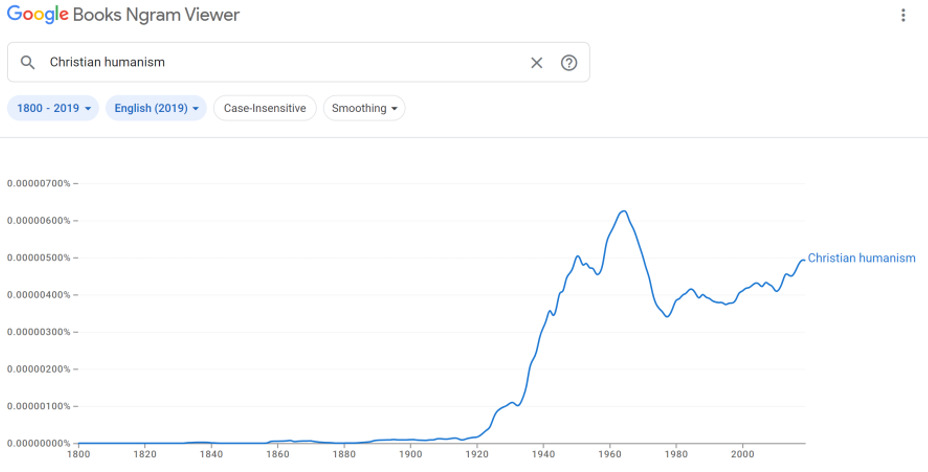
One can see the chronology of this humanist revival in the following Google Ngram Viewer[44] graph:
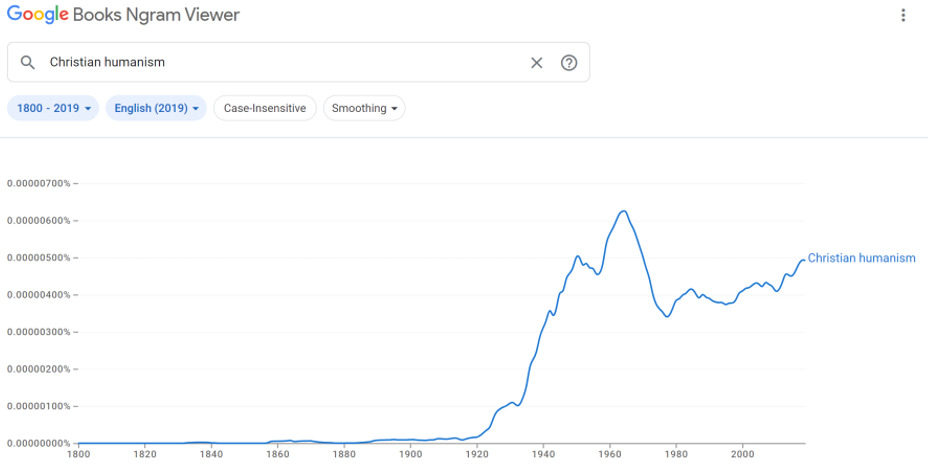
As you can see, the expression “Christian humanism” was rarely used in English writings prior to 1920. The initial explosion and steep rise of the phrase’s use occurred during and after the Second World War, with a long tail peaking in 1960, then declining to 1980, then beginning to revive again in the past few decades. This timeline maps exactly onto the period of ServiceMaster’s founding, growth, and maturing.
Although the English phrase “Christian humanist” is clearly of recent origin, I follow Jens Zimmermann[45] in seeing the tradition of Christian humanism as much older, stretching back to the roots of Christianity and indeed to Christianity’s early and long engagement with classical ideas, long before Renaissance thinkers coined the phrase studia humanitatis ac litteratum: “humane and literary studies,” which is the earliest etymological root of the phrase.
The tradition’s theological themes originated in the patristic period (that is, the church’s early centuries) and include (1) an understanding that both God’s creation of humanity in his own image and God’s incarnation in a human being have raised all people to a status “a little lower than the angels,” bequeathing to us a vocation as God’s representatives on earth, a mandate to develop creation into cultural goods, and an equal dignity eventually enshrined in rule of law, (2) an understanding, since Justin Martyr, that human reason is related both to the rationality of God and to the orderliness of creation—crucial to the rise of the sciences, and (3) a deeply orthodox understanding of salvation as the recovery of the image of Christ in us (theosis, “deification,” or “divinization”), framing all kinds of education and training as “Christ-formation” as well as imparting knowledge and skills.
In short, I join Zimmermann in taking this whole long tradition’s most determinative qualities to be theological—as related in particular to the central doctrines of human creation in the imago Dei and divine visitation in the Incarnation, the latter viewed not only as a theophany (revealing of God and his nature) but also as what we might call an “anthropophany”—an event and a person that show us true humanity. And I will argue that C. S. Lewis is almost the epitome of a modern Christian humanist in his attentiveness to human nature, purpose, and flourishing.
Second, I recognize, with Zimmermann, among this tradition’s phases—each with slightly differing emphases—not only early-church, medieval scholastic, and Renaissance forms of Christian humanism, but then also Reformation and modern forms as well, that asked humanist questions about every social institution, from politics to law to—significantly for our topic—marketplace engagement and economics.[46]
While this very old Christian tradition may seem remote from the culture and concerns of a twentieth-century corporation, one key link may be found in Christian humanism’s perennial focus on education. Since the earliest years of the church, the Christian humanist tradition was always tied closely to education of a “humanistic” sort—following the Greek philosophical tradition’s formative, paideia approach to education while adapting it within a gospel framework. The linkage from patristic humanism to Renaissance humanism (with the latter’s classical-inflected “humanistic studies”) to the spiritually formative didactic literary works of such modern Christian humanists as C. S. Lewis—and on to Bill Pollard’s (and Peter Drucker’s) understanding of management as a “liberal art”—is strong and direct, with the last connection being made in the setting of a Christian university.
Why Can We Be Confident in Characterizing C. S. Lewis as a Christian Humanist?
Again, Jacobs correctly (I believe) counts C. S. Lewis as a notable modern carrier of this tradition. By my own analysis, there are at least ten marks of Christian humanism strongly present in the thought of C. S. Lewis:
Classicism
First, like the earliest Christian humanists, Lewis was a classicist before he became a Christian,[47] and like the Christian humanists of every age, he never stopped pursuing “philosophy as a way of life,”[48] informed first by Scripture and tradition, but second also by truth wherever he found it—and he continued to find it in Plato, Aristotle, and their heirs.
Centrality of the Incarnation
Second, like the medieval Christian humanists, as a professional medievalist Lewis followed the early fathers in grounding his understanding of humanity and human culture in the Incarnation. Just two illustrations of this: First, while writing an introduction to his friend Sister Penelope Lawson’s English translation of Athanasius’s On the Incarnation,[49] Lewis completely absorbed a Greek copy of that work, annotating every page.[50] Second, in the radio talks that became Mere Christianity, he shows his debt to patristic humanism in its portrayal of the Incarnation, of Christ as true humanity, and of our salvation in the mold of the patristic teaching of theosis, as I will argue.
High View of Humanity
Third and related, Lewis, like his medieval and patristic sources, understood that by taking on human nature, God raised the dignity of what it means to be human. He thus believed, with all Christian humanists, that to be a Christian is to live a more fully human life and indeed to become more fully ourselves in our individual, particular humanity.
We see his high regard for all human beings throughout his life and writings. This manifested particularly in his habit of giving away money to all who asked, and to many whose need came to his attention. Owen Barfield, who was Lewis’s trustee as well as his friend, observed how Lewis followed this principle in his own life: “He gave two-thirds of his income away altogether and would have bound himself to give the whole of it away if I had let him. . . . There were substantial donations to charitable institutions, but what he really liked was to find someone through a personal connection or hearsay whose wants might be alleviated. He was always grateful to me for suggesting any lame dog whom my profession [as a lawyer] had brought to my notice.”[51] It is easy see behind this practice the Christian humanist anthropology of his “Weight of Glory” sermon, with its insistence that “you have never met a mere mortal.”
Lewis thus argued, “Giving to the poor is an essential part of Christian morality. I do not believe one can settle how much we ought to give. I’m afraid the only safe rule is to give more than we can spare. In other words, if our expenditure on comforts, luxuries, and amusement, is up to the standard common of those with the same income as our own, we are probably giving away too little.”[52] With the fundamental dignity and equality of all people as created in the imago Dei seemingly in mind, he did not worry about wasting his money on “undeserving types.” Instead, he reflected, “It will not bother me in the hour of death to reflect that I have been ‘had for a sucker’ by any number of impostors; but it would be a torment to know that one had refused even one person in need. After all, the parable of the sheep and goats makes our duty perfectly plain, doesn’t it?”[53]
As with all Christian humanists, Lewis’s high anthropology is anchored in Scripture’s portrayal of God’s own high view of humanity—as he gave us his image, shared our nature in the Incarnation, and redeems and resurrects us. In other words, Lewis held, as Zimmermann puts it, a “theo-anthropocentric” view.[54]
Theosis
Fourth, in Christian humanist fashion this incarnational understanding of humanity colored Lewis’s understanding of Christian salvation and the gospel. In short, Lewis understood and taught the patristic reading of salvation as theosis, which was the Christian humanist soteriology par excellence—that is, the view of salvation as the graced recovery by humans of our image-bearing nature, coming closer and closer to the likeness of Christ, who is the epitome of that nature. In Mere Christianity, he said we become “little Christs” who are like tin soldiers brought to life,[55] and throughout his writings he illustrated this understanding with a variety of analogies: God as deep-sea diver plunging down to bring us up,[56] dancers in a divine dance led by the Incarnate One,[57] and statues crafted by a sculptor and then brought to life by him.[58] Each of these images evoke the old idea—rooted in Athanasius’s thought and dominant in the East but shared as well by Augustine and the Western tradition—of salvation as theosis, usually translated into English as “deification” or “divinization.”
Ethical Eudaemonism
Fifth, on the question of how these precious humans are to flourish, like the classical thinkers and the older Christian humanists—from Boethius to Erasmus—Lewis was an ethical eudaemonist. That is, first, when asking about the telos and fulfillment of human life, he started where those earlier thinkers always started: with questions about the sources of human happiness (eudaemonia). Think of the title of his short religious memoir, Surprised by Joy, or his insistence in the “Weight of Glory” sermon that, given the scriptural language of reward and enjoyment, God is less likely to accuse us of desiring too much, and more of desiring too little. But second, also, Lewis’s eudaemonism, like the classical and old Christian versions, was always also ethical—it turned quickly, in an Aristotelian mode, to the virtues (both graced and practiced) as central to the happiness we may hope to experience in our lives with God and neighbor.
Virtue and Culture
Sixth, the process of becoming more and more like the full humanity epitomized by Christ was essential for Lewis, as it was for the whole Christian humanist tradition. Both saw our arts, sciences, cultural activities, and personal virtues and vices contributing to heaven or hell on earth, as well as to our progress in the Christian life. In his essay “Christianity and Culture,” Lewis reflects, “Culture is a storehouse of the best (sub-Christian) values. These values are in themselves of the soul, not the spirit. But God created the soul. Its values may be expected, therefore, to contain some reflection or antepast [i.e., foretaste] of the spiritual values.”[59] In this light, he came cautiously to the conclusion that the whole cornucopia of human culture-making and its related virtues is a divine directive—though in its various forms, and to various people, a particular cultural practice or product could either foster or impede Christian salvation and holiness.
Along with the above six qualities, Lewis’s thought also shared with the Christian humanism tradition (7) a strong emphasis on the material and social dimensions of flourishing (derived from the cultural mandate of Genesis); (8) an understanding of earthly flourishing as a foretaste of heaven (and thus doubly worthy of our attention and effort); (9) an emphasis on free will as a hallmark of humanity (and thus to be guarded for all people as a matter of basic justice); and (10) a view of education as paideia toward the attainment of the full, true humanity exemplified in Christ. And finally, this humanism was also, for Lewis as for the whole tradition, a retrieval of older values in times of crisis—such as faced the West in the period of the two World Wars and their aftermath (the time of ServiceMaster’s founding and initial rise).[60]
Of course, not every mark of Lewis’s Christian humanism was absorbed by or probably even noticed by ServiceMaster’s leaders. Nonetheless, it is clear that Lewis’s humanism may be counted as one important influence for those leaders, alongside such others as Drucker, who himself has been characterized as a Christian humanist, and who became a key influence on Pollard.[61]
How ServiceMaster’s Early Leaders Were Influenced by Lewis’s Christian Humanism
Despite American evangelicalism’s long-time appreciation for Lewis’s thought, it would be incorrect to say that ServiceMaster’s early leaders absorbed and practiced Christian humanist values because they were evangelical Protestant Christians. Rather, evangelicalism has historically proved resistant to many of these values. We see this, for example, in the fact that each of the early evangelical Protestant leaders of ServiceMaster wrestled personally, vocationally, with a perceived tension between “full-time (church-paid) Christian service” and business as vocation (not just as job).
For example, after graduating from Wheaton and marrying his wife Jean in 1942, Ken Hansen accepted an invitation to lead the small Bethel Community Church in Chicago, though he had not been trained as a pastor. ServiceMaster founder Marion Wade was among the congregants and, impressed by the young man, began to talk with Ken about ServiceMaster as a potential career path. But “Hansen was not so sure that business fit his idea of a Christian call.” Consistent with the culture of Wheaton College, Ken leaned more toward overseas missionary work. It took a long time and a family challenge, the birth of a son with Down syndrome, which would make travel difficult, before he reluctantly gave in to Wade’s urgings to join his company.[62]
This illustrates the fact that the vocation of business was in the twentieth century rarely celebrated, and often denigrated, among devout evangelicals of the Wheaton sort—except inasmuch as it might generate funds to support more “churchy” work.[63] Note, for example, the seventy-five-year-old Billy Graham’s devaluation of business and indeed earthly work altogether, in a short memorial message for ServiceMaster’s third CEO, Ken Wessner, read at Wessner’s 1994 memorial service by Bill Pollard. Said Graham, “The Lord used [Ken] as a businessman to help build a great business, but primarily his heart belonged to Christian work.”[64] The use of “but” here clearly puts “building a business” and “Christian work” against each other, as two opposites. It quite simply rules business out as “Christian work.”
More generally, twentieth-century evangelicals tended to reduce human action in the created world to second-class status, even spiritual irrelevance. This is what might be called a dimension of “soft Gnosticism” within evangelical thought. One of its marks was the characteristic reduction of people to “souls to be saved”—and thus a lack of attention to our development as full human beings.[65]
What Then Linked Early Servicemaster Leaders, Formed in an Evangelical Culture, to Lewis and His Christian Humanism?
I have suggested that ServiceMaster’s early leaders encountered and engaged C. S. Lewis and his ideas through Wheaton College. That Lewis’s influence loomed large in that institution is a commonplace. To take the example of just a few of Wheaton’s most personally influential figures for its students (according to a 2017 alumni survey) during the period of Hansen’s, Wessner’s, and Pollard’s engagement with the school:
-
Clyde Kilby was an English professor at Wheaton from 1951 to 1981, whose Lewis collection became the heart of the Wade Center and who was invited to lead groups reading the work of Lewis and related authors at Ken and Jean Hansen’s house.
-
Beatrice Batson was an English professor at Wheaton from 1957 to 1987 who was deeply engaged in Kilby’s development of the Lewis collection and the literary journal grounded in what later became the Wade Center.
-
Arthur Holmes was a prominent philosophy professor at Wheaton from 1951 to 1994 whose emphasis on faith-learning integration was Lewisian in its approach and in its insistence on holistic formation as central to the task of education.[66]
These people, in particular, had an influence on Wade, Hansen, Wessner, and Pollard. However, that influence went two ways. In the 1950s, Kilby, while engaged in a personal correspondence with C. S. Lewis, began developing a collection of the English author’s works at Wheaton, which later grew to include works by Tolkien, Chesterton, Sayers, and three other British authors related to Lewis’s thought and writings. Already at that time Wade had become an aficionado of Lewis’s work, and soon after Wade’s death in 1973, some of his friends and family “established an endowment in his memory to support the Collection, which was then renamed ‘The Marion E. Wade Collection.’ The collection grew over the years, and is now housed in its own building on the campus of Wheaton College where the Wade Center welcomes 10,000 visitors and researchers per year from all over the world.”[67]
The Wade Center became a premier repository of “Lewisiana,” supporting worldwide scholarship on Lewis and related writers and also focusing interests not only at Wheaton College but also in the surrounding community—including among business leaders who sought to put Lewis’s thought into practice in their vocations. ServiceMaster leaders’ engagement not just in founding and supporting the Wade Center but also in Wheaton board service, generous giving, and teaching in Wheaton classes all helped create the environment for the ongoing work of such later Lewis scholars as Alan Jacobs (now at Baylor) and Jerry Root.[68]
I would argue that though American evangelicals tended in the early decades of Lewis’s influence in this country (and some still tend) to use him as an apologetic club with which to beat the unsaved into God’s kingdom, those who studied his imaginative works and the philosophical commitments behind them were more likely to reach the Christian humanist heart of his thought. This was, in essence, his way of connecting philosophy, literature, and history to Christians’ vocations, the Christian life, and a Christian understanding of how humans are created to flourish.
For this and (no doubt) other reasons, Lewis’s thought suffused the Wheaton College campus during the period of ServiceMaster’s growth and after (to this day). I would argue that it was at least in part through campus leaders linked to literary study—especially in the bygone days of well-funded and well-enrolled English majors at American universities—that the college was able to resist the pseudo-Gnostic heritage that marked some significant parts of American evangelicalism. The writings especially of Lewis and his literary “friends” (MacDonald, Chesterton, Tolkien, Sayers, and others) stood starkly against the evangelical tendency to reduce people to “souls to be saved,” relegating our material and cultural lives to spiritual irrelevance—as reflected in Ken Hansen’s vocational struggle and Billy Graham’s words for Ken Wessner’s memorial service.
It is not surprising, then, that a Wheaton student such as Ken Hansen would pick up Lewis’s characteristic Christian humanism and carry it with him to the end of his life: “When living in Wheaton, the Hansens had hosted a weekly evening book discussion group in their home; this lively group, led by Clyde Kilby, covered works by the Wade authors, and was greatly enjoyed by both Ken and Jean. Indeed, Walter Hansen, son of Ken and Jean, remembers great appreciation for the works of the Wade Center’s authors [Lewis preeminent among them] being an important element of life in the Hansen home, with regular readings and references to their books frequently a part of family conversations.”[69]
Ken’s son Walter, emeritus professor of New Testament interpretation at Fuller Seminary, links that appreciation for Lewis with Ken’s modus operandi as CEO at ServiceMaster: “I have no doubt that Lewis was one of the primary sources of wisdom, insight, guidance for my father and his leadership in the business.”[70] By the 1990s this Lewis influence had become regularized within the company, such that Patricia Asp remembered that the executive “Delta group” retreats, for which there was always a stack of assigned readings, featured Lewis’s works on more than one occasion.
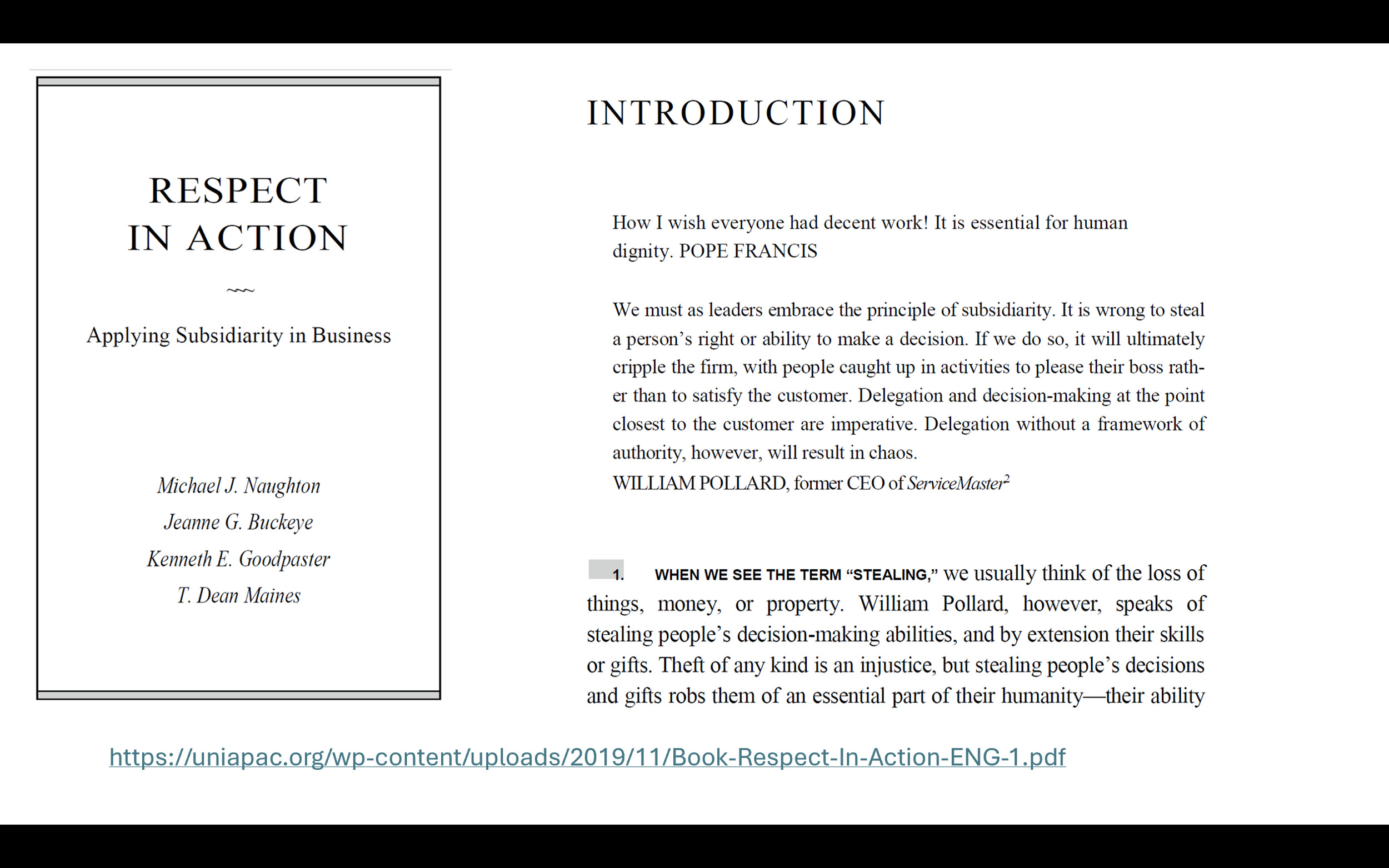
There are, as I’ve suggested, other channels of Christian humanist thought that no doubt influenced ServiceMaster’s early leaders. Alongside Wade’s personal religious experience and Hansen’s personal biblical reading, Reformed scholars well known among evangelical Protestants taught that “all truth is God’s truth” and that Christ’s presence is to transform every area of human culture. As noted, Carlos Cantu came from the Catholic tradition, where authors regularly applied Christian humanist ideas to work and economics. The social encyclicals of the nineteenth- and twentieth-century Catholic Church bear deep marks of Christian humanist thought, and Popes John Paul II and Benedict XVI are both understood by Catholic scholars to be Christian humanists. As evidenced in the Pollard Papers at Seattle Pacific University, Pollard read modern Catholic sources avidly, underlining and interacting with them and sometimes even contributing to them—as in the short book Respect in Action: Applying Subsidiarity in Business, by a group of professors in the Catholic Social Thought program at the University of St. Thomas in Minnesota. Here you can see the first page, which juxtaposes quotes from Pope Francis and Pollard:
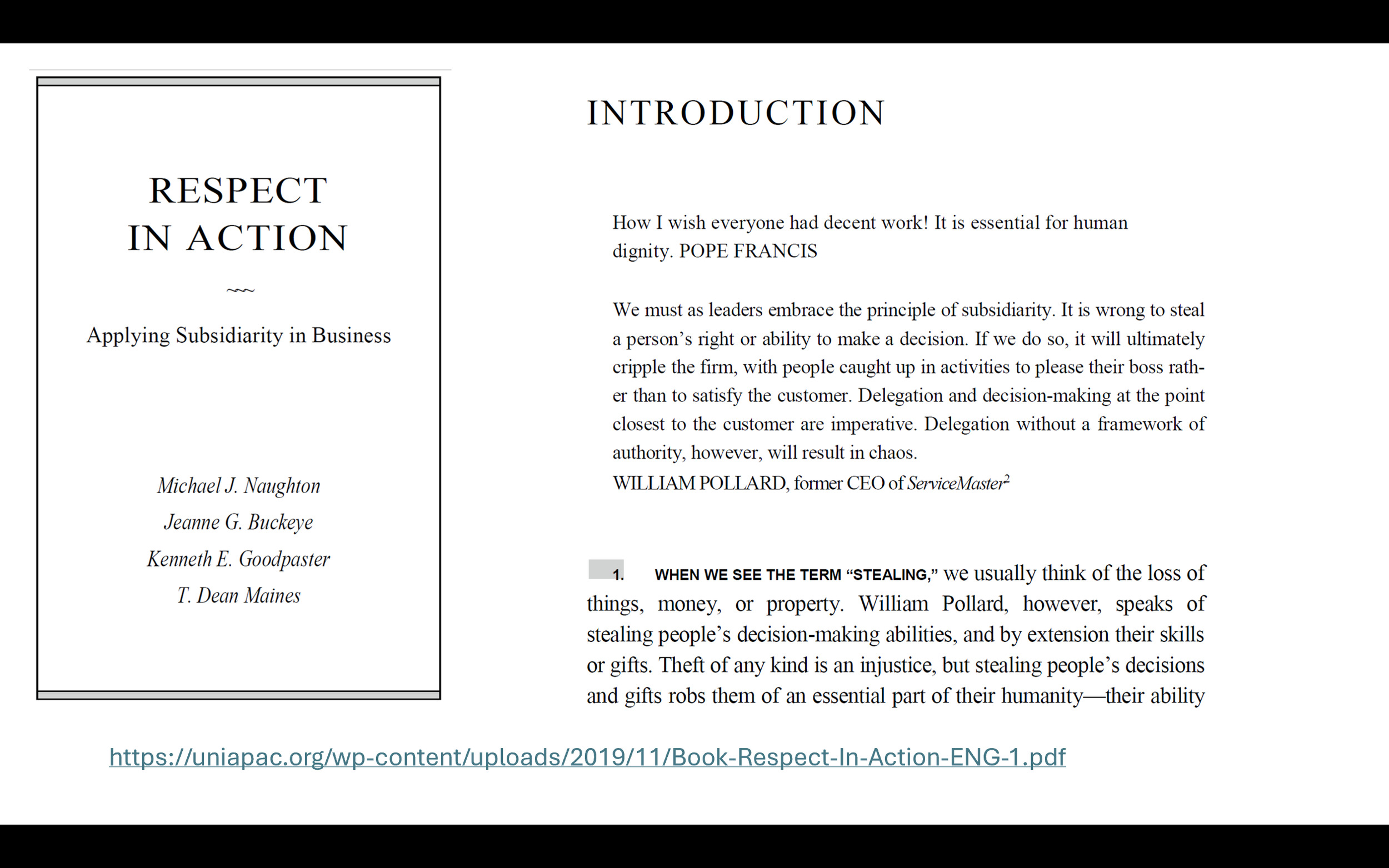
Roman Catholic scholars’ explicit integration of Christian humanism with business and economics is demonstrated in a recent volume coedited by Martin Schlag of the University of St. Thomas’s Center for Catholic Studies, Humanism in Economics and Business: Perspectives of the Catholic Social Tradition.[71] See also Naughton et al., The Vocation of the Business Leader, which draws strongly from the Christian humanism of Popes John Paul II and Benedict XVI.[72]
Conclusion: What Difference Christian Humanism Made to the Success of ServiceMaster
In conclusion, I take ServiceMaster to have been a unique evangelical implementation of Christian humanist principles, infused in the company’s culture over its first seventy years by leaders who came to these principles by a variety of roads, none more evident than the work of Wheaton College’s “patron saint,” C. S. Lewis.
If I am right, and ServiceMaster was informed by Christian humanist ideas (whatever the details of that line of influence), then we might ask: What concrete difference would that make to the success of ServiceMaster as a business, contributing to the economic life of the United States and eventually the world?
A parallel case suggests the “cash value” of such humanist ideas in business. It comes, fittingly, from the work of a Wheaton emeritus professor of economics, Peter J. Hill. Hill’s 2020 article “The Religious Origins of the Rule of Law”[73] cites “World Bank research” as indicating “that a one-standard-deviation increase in the rule of law index increases GDP by 300%”—and cites another scholarly finding that “five rule-of-law variables explain about 80 percent of the variance in nonoil GDP per capita.”[74] Hill then convincingly traces the development of this economically momentous tradition of rule of law to the historical Christian understanding of humanity as made in the image of God—placing everyone from a king to a menial worker at the same level of infinite worth and dignity, by virtue of which all people are entitled to the same protections under the law.
Resonating with Hill’s argument, in this article I’ve observed that the imago Dei and the Incarnation are at the crux of the long tradition of Christian humanism; that American evangelical Protestantism for various reasons ignored or resisted that tradition; that the tradition nonetheless penetrated the culture of a flagship evangelical institution; that it did so largely through the thought of C. S. Lewis, his circle, and key influential leaders on campus who engaged literature as a way to understand how to live a fully human life; and that in the twentieth century this humanist tradition proved still to have great power for the economic life of the United States, as demonstrated in the ServiceMaster case.
For here we have a company that, by implementing the idea that “we have never met a mere mortal,” achieved a stunning, sustained, twenty-nine-year increase in revenue, contributing to the flourishing of its employees, its customers, and their communities—a powerful real-world impact.
It is worth noting that while the influence of Christian humanism in this success seems patent, both Wade and Pollard understood the dangers of instrumentalizing those faith-derived understandings. Wade said, “I was not asking for personal success as an individual or merely material success as a corporation. I do not equate this kind of success with Christianity. Whatever God wants is what I want. But I did try to build a business that would live longer than I would in the marketplace that would witness to Jesus Christ in the way the business was conducted.”[75]
And Pollard later said, “One should [not] expect or promote financial success or gain from seeking to honor God.”[76]
Finally, one might point to the people-first doctrine of ServiceMaster and say: It could have come from any number of sources besides the Christian humanist tradition, including secular ones. That’s true enough. One possible answer might be: It could have, but it probably did not.
But this suggests one more important link between ServiceMaster’s people-first approach and Christian humanism, as described in the work of Regent College theologian Jens Zimmermann. In a number of books, Zimmermann shows how values that are still honored in secularized cultural sectors and work settings, such as “a common humanity, universal reason, freedom, personhood, human rights, human emancipation and progress,”[77] demonstrably originated in orthodox humanist commitments such as the imago Dei; the Incarnation as a revelation of true humanity and an affirmation of embodied, enculturated human life; salvation as theosis (the long, slow regaining of Christ’s likeness, and thus full humanity); education as paideia; and more. The ServiceMaster story as a case study shows both how these values support human agency, freedom, and equality of opportunity within marketplace work settings, and—as Hill similarly argued about the rule of law—how these values, not entirely absent from larger American culture and often assumed to have come from heterodox or agnostic Enlightenment thinkers, in fact emerged from core Christian understandings, mediated in this case through the Christian humanism of C. S. Lewis.
James Heskett, “ServiceMaster; We Serve,” HBS Case Study N9-900-030, Harvard Business School (June 6, 2000).
The exact words are Al Erisman’s, in Albert M. Erisman, The ServiceMaster Story: Navigating Tension Between People and Profit (Hendrickson, 2020), 126. They summarize Heskett’s conclusion in his book The Culture Cycle (FT Press, 2011).
Arguments for historical influence are always fraught, complex, and (if we historians are honest) to some degree circumstantial. All human thinking, motivation, and action, whether undertaken by an individual or a group, is overdetermined. That is, our inner lives are many-layered, such that under scrutiny there is always one more influence, one more principle that helps explain our motivations. Why, then, pursue such arguments for influence? Because despite their difficulty, they have the potential to illuminate our understanding of historical actors in new and fruitful ways. That, at least, is my goal in this essay.
On the Sermon on the Mount and the beatitudes as a key textual site informing traditional Christian understandings of human flourishing, see Jonathan Pennington, The Sermon on the Mount and Human Flourishing: A Theological Commentary (Baker Academic, 2018). Elsewhere I argue that Christian virtue ethics—forged in the late-ancient Christian-classical synthesis, lost in the early modern and modern eras, and retrieved again starting in the middle of the twentieth century—is Christian humanist. Per Belgian Catholic theologian Servais Pinckaers, that tradition is significantly grounded in the beatitudes. See Pinckaers, Sources of Christian Ethics (Catholic University of America Press, 1995).
See, for example, Tom Holland, Dominion: How the Christian Revolution Remade the World (Basic Books, 2019); and Rodney Stark, The Victory of Reason: How Christianity Led to Freedom, Capitalism, and Western Success (Random House, 2005).
For a clear introductory account of this secular humanist movement and its (sometimes acknowledged) debts to the long Christian humanist tradition, see Angus Ritchie and Nick Spencer, The Case for Christian Humanism: Why Christians Should Believe in Humanism, and Humanists in Christianity, a report from the Theos think tank in the UK, with a foreword by former archbishop of Canterbury Rowan Williams; https://www.theosthinktank.co.uk/research/2014/12/05/the-case-for-christian-humanism.
“Culture war” is a term coined by sociologist James Davison Hunter; see Culture Wars: The Struggle to Define America (Basic Books, 1991).
The image of modern Western culture and its supposedly Enlightenment-derived values as in fact a “cut flower” from Judeo-Christian roots—beautiful but unsustainable without their originating beliefs—was used by Jewish theologian and sociologist of religion Will Herberg in his 1951 book Judaism and Modern Man; again by Quaker theologian D. Elton Trueblood in The Predicament of Modern Man (1965); and more recently by theologian and social critic Os Guinness in Impossible People: Christian Courage and the Struggle for the Soul of Civilization (2016) and Our Civilizational Moment: The Waning of the West and the War of the Worlds (2024).
Jens Zimmermann, Re-Envisioning Christian Humanism: Education and the Restoration of Humanity (Oxford University Press, 2016), 6.
“On this cultural heritage, even non-Christians often agree, as indicated by the judgement of atheist historian, philosopher, and statesman Benedetto Croce (1866–1952), who admits that ‘in our moral life and thought we feel ourselves literally the children of Christianity.’” Zimmermann, Re-Envisioning, 7, citing Croce, My Philosophy and Other Essays on the Moral and Political Problems of Our Time (Allen & Unwin, 1949), 46.
Marion Wade started his company at the time of the Great Depression in 1929 when he couldn’t find a job. Until his accident, he had never thought about any connection between his Christian faith and his work, beyond working hard and acting fairly.
Erisman, The ServiceMaster Story, 13–14, quoting first Richard Hattwick, “Marion Wade, Ken Hansen, Ken Wesner,” October 24, 2014, American National Business Hall of Fame, http://anbhf.org/laureates/servicemaster/; and then Marion E. Wade, The Lord Is My Counsel: A Businessman’s Personal Experiences with the Bible (Prentice-Hall, 1966), 83–84.
Wade, The Lord Is My Counsel, 7, quoted in Erisman, ServiceMaster Story, 26. This was not just a private motto. In a tribute to Wade, Robert S. Pierre noted, “His constant reminder to his co-workers was very simple: ‘If you don’t live it, you don’t believe it.’ He believed it and he lived it.” Book of Remembrances (September 2001), Marion E. Wade Center, Wheaton College, Wheaton, Illinois.
Erisman, ServiceMaster Story, 47.
From Bill Pollard’s notes on an unpublished autobiography by Hansen, from which Ken’s family had given Pollard permission to extract material; quoted by Erisman, ServiceMaster Story, 44.
See Hansen Series page at Intervarsity Press, https://www.ivpress.com/hansen-series?srsltid=AfmBOorOlcsMOR4NJa1HOpadjRTwJtMCs_vkme_SFB-ZeqaRgBlsM3Ff.
Erisman, ServiceMaster Story, 47; quotations are from Wade, The Lord Is My Counsel, 139.
Bill Pollard, The Soul of the Firm (HarperBusiness, 1996), 9.
Paul Bert, conversation with Al Erisman, quoted in the latter’s ServiceMaster Story, 134.
This quote may be apocryphal. I was unable to find it in any printed source written by or quoting Henry Ford.
William Pollard, “Management as a Liberal Art,” 2–3; Pollard Collection, Seattle Pacific University. Pollard took this notion of management as a liberal art from Peter Drucker, whom he cites extensively in the article.
Pollard, “Management as a Liberal Art,” 6.
Wade, The Lord Is My Counsel, 105–6.
Erisman, ServiceMaster Story, 87.
Ken Wessner commented, “Training, indeed any management directive, is not so much about what we want people to do, but rather what we want people to be.” Erisman, ServiceMaster Story, 87–88.
1970–1999; Erisman, ServiceMaster Story, 1. Supporting graphs may be found in chapters 3–7.
“There was an important reason that ServiceMaster leaders made the distinction between end goals and means goals. If, as in many companies maximizing profit is the end goal then treating workers well is in the company’s best interest because that will cause them to work harder and the company will make more money. But ServiceMaster recognized that philosophy as exploitive rather than truly valuing the worker. Pollard had stated many times, ‘People are the subject of work, not the object of work.’ The worker is not merely another tool of production. To honestly care about the person who works, as an end goal as captured in the first two objectives, changes all of that.” Erisman, ServiceMaster Story, 157–58.
For a set of historical, theological, and philosophical reflections on this essential harmony between people and profit by Christian scholars, see Domènec Melé and Martin Schlag, Humanism in Economics and Business: Perspectives of the Catholic Social Tradition (Springer, 2015).
Erisman, ServiceMaster Story, 62.
Erisman, ServiceMaster Story, 53–54.
Erisman, ServiceMaster Story, 54, quoting Allan Emery, A Turtle on a Fencepost (WorldWide, 1979), 96, and Jim Huse in conversation with Al Erisman.
Erisman, ServiceMaster Story, 75.
Erisman, ServiceMaster Story, 85.
Ken Wessner, “Building a Winning Team,” a presentation to the company’s Delta Lambda Kappa management group (usually called the “Delta Group”), September 23, 1986, White Sulphur Springs, West Virginia; in Erisman, ServiceMaster Story, 86–87. Erisman explains the name of the Delta Group, which was instituted by Hansen as chairman during Wessner’s time as CEO: “Delta, representing change; Lambda, the first letter of the Greek word for ‘service’; and Kappa, the first letter of the Greek word for ‘master.’ It comes together as ‘Changers of ServiceMaster’” (85).
Erisman, ServiceMaster Story, 93–94.
See, for example, “Micromanagement and Lack of Autonomy: Key Stressors in the Modern Workplace,” Davenport Psychology, https://davenportpsychology.com/2024/04/08/micromanagement-and-lack-of-autonomy-stressors/; see also Barry Schwartz, Why We Work (Simon & Schuster/TED, 2015).
Erisman, ServiceMaster Story, 95.
Patricia Asp, interview with this article’s author, February 18, 2025.
William Pollard, Serving Two Masters? Reflections on God and Profit (HarperCollins, 2006), 71–72, cited in Erisman, ServiceMaster Story, 111.
Pollard, Soul of the Firm, 106.
Erisman, ServiceMaster Story, 124.
C. S. Lewis, “The Weight of Glory,” in The Weight of Glory (HarperCollins, 2001), 46.
Alan Jacobs, The Year of Our Lord 1943: Christian Humanism in an Age of Crisis (Oxford University Press, 2018).
Google’s Ngram Viewer is a tool that draws from that company’s massive database of scanned books to allow a user to trace the English usage of phrases during the period 1800 to 2019.
Jens Zimmermann works out the definition and history of Christian humanism most systematically in his Incarnational Humanism: A Philosophy of Culture for the Church in the World (IVP Academic, 2012) as well as Humanism and Religion: A Call for the Renewal of Western Culture (Oxford University Press, 2012). He also summarizes the story in the introduction of his edited volume Re-Envisioning Christian Humanism.
All this is well-documented and described in Zimmermann’s scholarship.
This owed much to Lewis’s early training under an Irish tutor, William Kirkpatrick. See, e.g., Lewis, Surprised by Joy: The Shape of My Early Life (Harcourt Brace, 1955), chap. 9, “The Great Knock.”
The phrase is Pierre Hadot’s. See Adam Barkman, C. S. Lewis and Philosophy as a Way of Life (Zossima, 2009) for an exhaustive account of Lewis’s philosophical journey.
C. S. Lewis, “Introduction: On the Reading of Old Books,” in On the Incarnation (St Vladimir’s Seminary Press), 3–10.
This copy is in the archives of the University of North Carolina at Chapel Hill.
Owen Barfield, Owen Barfield on C. S. Lewis, ed. G. B. Tennyson, 2nd ed. (Barfield Press, 2011), 14.
C. S. Lewis, Mere Christianity (HarperOne, 2001), 86.
C. S. Lewis, Letters to an American Lady, ed. Clyde S. Kilby (Eerdmans,1967), 114.
Zimmermann, Re-Envisioning Christian Humanism, 5–6.
Lewis, Mere Christianity, pt. 4, chap. 5.
Like the diver working on a salvage project, Christ goes down into his own creation “in order to bring the whole ruined world up with him to new life.” See Paul S. Fiddes “On Theology,” in The Cambridge Companion to C. S. Lewis, ed. Robert MacSwain and Michael Ward (Cambridge University Press, 2010), 98; citing Lewis, Miracles (HarperCollins, 1960), 115.
“The partner who bows to Man in one movement of the dance receives Man’s reverences in another. To be high or central means to abdicate continually: to be low means to be raised: all good masters are servants: God washes the feet of Men.” See Fiddes, “On Theology,” 94; citing Lewis, Miracles, 128. Fiddes comments, “Lewis’s fundamental insight is that, by entering the dance or drama of the Trinity, we truly become sons and daughters of God; we truly become persons” (94, emphasis added).
What happens to us in that process is akin to what happens to the creatures who were turned to stone in the White Witch’s courtyard: though we now may be only static pictures of God, made in his “sculptor’s shop,” “some of us . . . some day [are] going to come to life” under the vivifying power of the breath of the dying-and-rising Aslan. Chris Armstrong, Medieval Wisdom for Modern Christians: Finding Authentic Faith in a Forgotten Age with C. S. Lewis (Brazos, 2016), 198; citing Fiddes, “On Theology,” 94; from Lewis, Mere Christianity, 136.
C. S. Lewis, “Christianity and Culture,” Theology 40, no. 237 (1940): 177.
These Christian humanist facets of C. S. Lewis’s thought and writings are examined at greater length in Chris R. Armstrong, “The Christian Humanism of C. S. Lewis’s Abolition of Man,” Journal of Religion, Culture & Democracy, December 2023, https://doi.org/10.54669/001c.90878.
See, for example, Ian F. McNeely, “Peter Drucker’s Protestant Ethic: Between European Humanism and American Management,” Modern Intellectual History 17, no. 4 (2020): 1069–97.
Erisman, ServiceMaster Story, 40. See Erisman’s accounts, chapter by chapter, of each early CEO’s life and vocation.
In fact, this antipathy to business vocations in American churches was broader than the evangelical tradition, as chronicled in David Miller, God at Work: The History and Promise of the Faith at Work Movement (Oxford University Press, 2006).
Pollard Papers, Seattle Pacific University.
Chris R. Armstrong, “Getting Earthy: God’s Second Book—the Natural World,” in Medieval Wisdom for Modern Christians, 139–64.
A brochure from the Wheaton archives on Holmes’s life and work notes, “Similar to the thoughts of C. S. Lewis, Holmes advocates that education is the center piece of a Christian College. If students are being called to a time of study, it seems clear that through this education and honing of the mind that God can be glorified. Education should be valued quite highly, and Holmes thinks, ‘The question to ask about an education is not “What can I do with it?” but rather “What is it doing to me—as a person?” Education has to do with the making of persons, Christian education with the making of Christian persons.’”
“About the Wade Center,” Marion E. Wade Center website, Wheaton University, https://www.wheaton.edu/academics/academic-centers/wadecenter/about/.
Albert Erisman, personal correspondence with the author, April 2025.
“Hansen Family Biographies: Ken & Jean Hansen,” Marion E. Wade Center website, https://www.wheaton.edu/academics/academic-centers/wadecenter/events/ken-and-jean-hansen-lectureship/hansen-family-biographies/.
Walter Hansen, interview with the author, February 18, 2025.
Edited by Domènec Melé and Martin Schlag (Springer, 2015).
The Vocation of the Business Leader, 5th ed. (Dicastery for Promoting Integral Human Development, 2018), https://cas.stthomas.edu/_media-library/_documents/catholic-studies/vocation-of-the-business-leader.pdf.
Peter J. Hill, “The Religious Origins of the Rule of Law,” Journal of Institutional Economics 16, no. 3 (2020): 305–18.
Hill, “The Religious Origins of the Rule of Law,” 305.
Pollard, Serving Two Masters, 27.
Pollard, Serving Two Masters, 34.
Zimmermann, Re-Envisioning Christian Humanism, 6.